


As businesses move online, implementing strong digital identity systems is essential for streamlining operations, building trust, and ensuring customer safety. However, this digital shift has also triggered a dramatic rise in sophisticated cyberattacks, including online fraud, account takeovers, synthetic identities, and conventional identity theft.
As reported by the Business Information Industry Association (BIIA), identity-related financial fraud has increased by about 12% annually since 2020, while synthetic identity fraud now accounts for roughly 30% of all identity fraud cases.
To combat these threats, organizations must leverage both identity verification and authentication as complementary security steps.
Before exploring these solutions, it is crucial to understand that they perform distinct functions and address entirely different security challenges.
Understanding Identity Verification
Identity verification is crucial for securing your company’s data.
So, here’s a detailed guide on how it works:
What Is Identity Verification?
Identity verification is the process of confirming that a person is who they claim to be, ensuring the authenticity of an individual’s claimed identity. It adds a security layer that protects people’s identities and saves their accounts from vulnerabilities.
Have you come across a website that says, “To access this information, please verify your identity”? That is a perfect use case of identity verification.
Verification is vital for online settings and brick-and-mortar stores. In both cases, customers’ personal data, including transactions and purchase history, are recorded in the system for better communication and customer interactions.
What Are the Main Methods of Identity Verification?
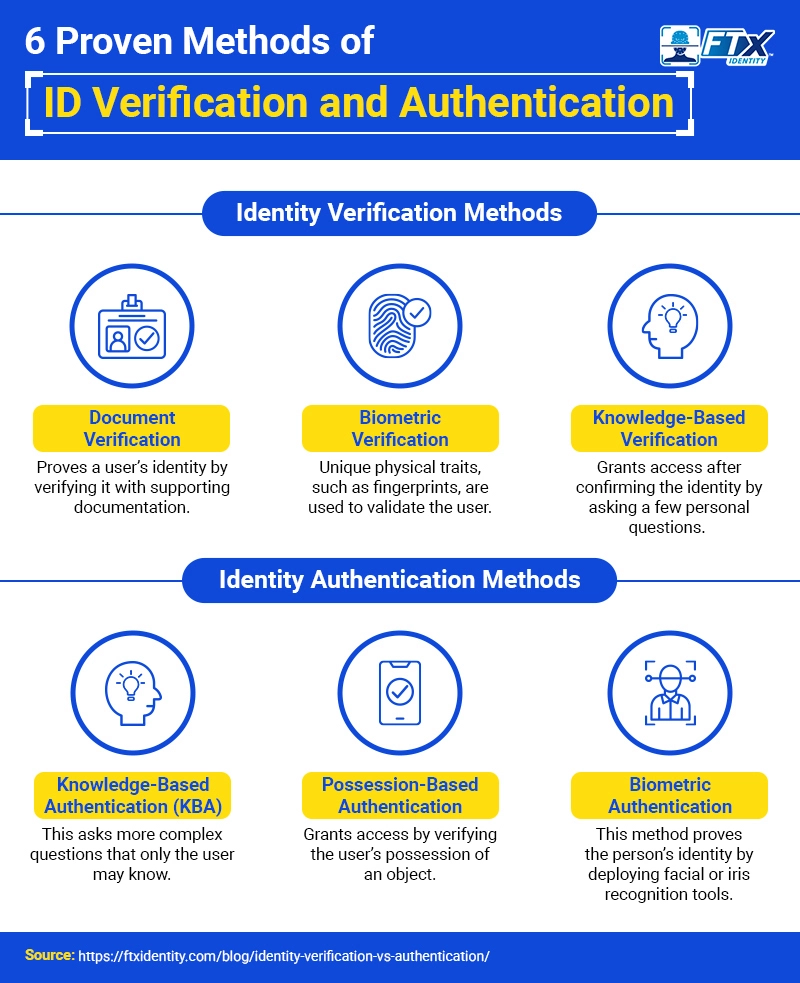
The main methods of identity verification are document verification, biometric verification, and knowledge-based verification. Each confirms an individual’s identity using a different type of evidence.
1. Document Verification
Identity document verification is a process that confirms a person’s identity by providing supporting documentation.
For example, immigration officers always ask for relevant documents before granting a visa, such as a passport, travel tickets, hotel booking, etc. Moreover, they ask many questions about the documents and their identity; this ensures the person is who they claim to be.
Other types of documents used in verifications are:
- Driver’s license
- Social security card
- National ID card
- Employment ID document
- Bank statements
2. Biometric Verification
The identity biometric verification process uses a person’s unique physical or behavioral traits to confirm their credentials. It matches the person’s document against their physical characteristics like iris, fingerprints, facial recognition, or voice patterns to confirm identity.
The most common use cases of biometric identity verification include:
- Banking and financial institutions
- Age-restricted companies
- Mobile and web shopping portals
- Government agencies (such as law enforcement)
- Healthcare
- Retail sector
- Immigration offices
3. Knowledge-Based Verification
Knowledge-based verification (KBV) is widely used on online platforms as a two-step verification process. It generally starts with asking questions related to the user’s personal details. These questions validate a person’s identity and grant access to sensitive or financial information.
A few examples of knowledge-based verification are:
- What is the name of your first pet?
- What was your previous address?
- What is the name of your first school?
- What is your mother’s maiden name?
Knowledge-based verification is commonly used in industries such as:
- Ecommerce websites
- Age-restricted products (such as tobacco and cannabis)
- Banking and insurance companies
- Healthcare
What Role Does Identity Verification Play in Fintech and Other Industries?
Identity verification is critical to fintech and regulated industries, underpinning KYC compliance and identity theft prevention. It continues to grow in importance across industries, especially in fintech.
According to Grand View Research, the global identity verification market was valued at $13.4 billion in 2025 and is projected to reach $38.5 billion by 2033, driven by increasing demand for secure digital identity solutions.
A few of the examples of fintech identity verification are:
1. KYC (Know Your Customer) Regulations
In many industries, including Fintech, it is mandatory to adhere to KYC regulations. ID verification ensures financial institutions and other data-sensitive companies have complied with government regulations to provide accurate customer information and reduce the risk of fraudulent activities like money laundering.
It is a mandated step for:
- Opening a bank account
- Anti-money laundering compliant
- Return and Acceptance of checkbook
- Loan processing
2. Identity Theft Prevention
Identity verification can help prevent identity theft across various industries. It acts as a gateway and safeguards your personal data from getting into the wrong hands. Three crucial steps of identity theft prevention are:
- Do not disclose your personal information, and keep it secure
- Regularly monitoring your credit card and bank statements
- Restrict the use of public computers to access sensitive information

What Are the Main Methods of Identity Authentication?
The main identity authentication methods are knowledge-based authentication, possession-based authentication, biometric authentication, and multi-factor authentication. Each offers unique advantages.
1. Knowledge-Based Authentication (KBA)
This identity authentication method validates a user’s identity through information only the user should know.
For example: Passwords, security questions, social security numbers, PINs, or personal questions.
To maintain higher security standards, there are mainly two types of KBA:
Static – They are a set of questions that users can select from various security questions. The only drawback with these questions is that anyone can learn their answers after a few interactions.
For example:
- Who was your childhood friend?
- Where was your last vacation?
Dynamic – These security questions are more specific, personal, and complex for fraudsters to answer. They are mainly real-time questions, and they are compiled based on the user’s public records or credit reports.
For example, in which of the following addresses did you previously reside? What car was registered for you in Rock Hill in 2010?
2. Possession-Based Authentication
As a two-factor authentication (2FA), possession-based authentication grants access by verifying the user’s possession of an object.
For example: security tokens on hardware devices like mobile devices.
3. Biometric Authentication
The only difference between biometric authentication and verification is the level of security. While verification only confirms a person’s identity, authentication proves the person’s identity by deploying several authentication methods.
This method authenticates profiles based on their unique physiological or behavioral characteristics.
For example: fingerprints, facial recognition, iris recognition, or audio check.

4. Multi-Factor Authentication (MFA)
This authentication method ensures that users enter two or more authentication steps to access the page or information to reduce the risk of unauthorized access.
For example: a combination of password and security questions OR password and authorization link sent to an email address.
Role in Cybersecurity
The role of identity authentication in cybersecurity is to flag and catalog fraudulent activities and profiles. Further, it records and authenticates the activities of the genuine ones. This way, each system gets notified of the red flags and how to avoid them. Identity authentication in cybersecurity serves in various ways, such as:
1. Protecting Accounts and Data
ID authentication methods protect the data by ensuring that only authorized individuals gain access to it. This identity verification method prevents unauthorized users, such as scammers, from phishing and compromising sensitive accounts and data.
2. Two-Factor Authentication (2FA)
2FA requires users to enter two separate authentication methods before granting access. This additional security layer protects companies against unauthorized access.
| Key Difference | Identity Verification | Identity Authentication |
|---|---|---|
| Purpose | It confirms and validates a person’s identity with the presented information or documentation. | The user’s identity is matched with supporting data, such as biometrics, before granting access to systems. |
| Process | It cross-checks the user’s personal information or documents. | It utilizes methods such as MFA, 2FA, biometrics, or possession verification. |
| Level of Assurance | Any form of identity verification has high accuracy levels. | Identity authentication adds an extra layer of security, making it more popular, reliable, and unbreachable. |
| Regulatory Requirements | Identity verification tools must be compliant with industry regulations and KYC standards. | ID authentication requires the same as ID verification with additional data protection and cybersecurity regulations. |
| Access Control |
It only verifies the document and the user’s identity. For example, train or flight ticket |
It has high scrutiny levels and authenticates users to grant or deny access to services based on ID confirmation. For example, granting visas and buying age-restricted products. |
| User Experience | Generally quick, less intrusive, and requires minimal document submissions | Can be lengthy and tedious, requiring more authentication method |
How Businesses Use Identity Authentication & Verification
The latest authentication and identity verification methods use technology and AI for better, more secure verification. Businesses use both types of identity checking in their operations for customers, access control, and employee verification.
1. Authentication Methods
- Access Control: Businesses use identity authentication to control sensitive data and system access. Employees are given unique login credentials and sometimes additional authentication factors to ensure that only authorized individuals can access certain information.
- Financial Transactions: Banks and other financial institutions use identity authentication to verify the identity of users making transactions. This can involve multiple authentication factors, such as a password, a one-time code sent to a registered phone number, or a fingerprint scan on a mobile banking app.
- Regulatory Compliance: Many industries have regulations requiring certain levels of identity authentication. For example, healthcare providers must authenticate users’ identities when accessing electronic health records to comply with HIPAA regulations.
2. Verification Methods
- Customer Onboarding: Financial institutions like banks and insurance companies use identity verification during customer onboarding. They verify the identity of new customers against government-issued IDs and other documents to comply with Know Your Customer (KYC) and Anti-Money Laundering (AML) regulations. This process helps prevent fraud and illegal activities.
- Online Marketplaces: Online platforms such as e-commerce sites, ride-sharing services, and home-sharing services use identity verification to build trust and safety. For instance, a home-sharing platform may require hosts to verify their identity by uploading a government-issued ID or taking a selfie. This helps ensure that the person listing the property is who they claim to be, creating a safer environment for guests.
- Telecommunications Companies: Telecom companies use identity verification when issuing (subscriber identity module) SIM cards to customers. They verify the customer’s identity against a government-issued ID to ensure the SIM card is not being issued for fraudulent purposes. This is particularly important in countries where regulations require telecom companies to verify the identity of their customers.
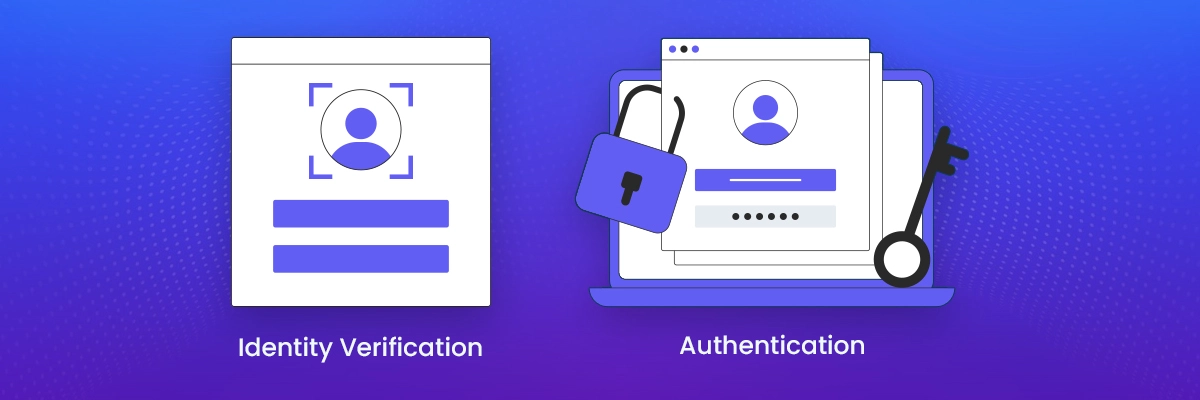
Businesses and customers could be at risk because of the confusion between verification and authentication. Instead of giving two separate services, some solution suppliers combine the two, which furthers the misconception.
Identity verification tools can’t always guarantee that the person providing the identifying information is the true owner of it. A business becomes exposed to account takeover fraud and fake identities if it treats a verified identity (“the identity exists”) as authenticated or proofed (“the user is who they say they are”).
How Weak Verification and Authentication Increase Security Risks
Weak verification and weak authentication fail in different ways. The first lets fraudsters create fake accounts and slip through onboarding; the second leaves real accounts exposed to takeovers, password leaks, and SIM swap attacks.
Risks of Weak Verification
When companies put in place shallow identity checks while onboarding new customers, they open the door to significant risks:
- Fake account creation: Fraudsters exploit document checks or the absence of identity verification to create fake identities. These fake identities are then used for abuse.
- Bot registrations: Automated scripts and bots can overwhelm the platform when people sign up. They can create many accounts quickly without anyone stopping them.
- First-party and third-party fraud: Inadequate vetting allows malicious actors to intentionally open accounts with no intent to pay (first-party) or use stolen or fabricated credentials to commit external fraud (third-party) under a shielded identity.
Risks of Weak Authentication
Not having ways to keep users logged in and access working properly can put user accounts and company networks at a big risk.
- Account takeovers (ATO): Without multi-factor authentication, cybercriminals can easily compromise credentials to hijack legitimate user accounts, locking out the true owners and draining funds or exfiltrating sensitive data.
- Password leaks: Organizations that use single-factor passwords that never change are at risk of attacks where stolen login details from one place are used to break into other accounts.
- SIM swap attacks: Authentication systems that rely on SMS-based verification codes can be vulnerable to telecom-based fraud. Criminals may trick mobile carriers into transferring a victim’s phone number to a SIM card they control, allowing them to receive 2FA codes and potentially bypass account security protections.
Security and Fraud Prevention
With most businesses working on digital platforms, it is crucial to safeguard digital transactions and sensitive data and prevent fraudulent activities. Robust security measures and identity verification software are imperative to secure your company’s data from:
1. Identity Verification for Fraud Prevention
Here are the top four ways to secure the company data from fraudulent and phishing activities:
- ID verifications act as a firewall against identity theft and fraud by confirming the legitimacy of an individual’s identity.
- Robust verification methods scrutinize identity documents and reduce the risk of malicious activities under false identities.
- Biometric verification adds an extra security layer, ensuring that individuals presenting their IDs are genuinely who they claim to be.
It is crucial for sectors like finance and eCommerce, where the risk of data breaches is high.
2. Identity Authentication for Security
Here are the top 4 ways that identity authentication works to secure your company information:
- It safeguards sensitive data and acts as a gatekeeper protecting documents from unauthorized access.
- ID authentication adheres to regulatory compliance, industry regulations, and standards, ensuring the company is safe from legal obligations.
- It reduces the risk of unauthorized access, data breaches, and other security vulnerabilities.
- ID authentication ensures the overall security of the business.
How to Ensure Good Customer Experiences
Ultimately, these safeguards shouldn’t ruin a good user experience. Customers will experience negative effects due to overly intrusive verification procedures, which could eventually result in customer churn.
Authentication procedures must be smooth to allow businesses to compete without suffering the adverse effects of a bad customer authentication experience.
According to a CMO Council study, 61% of customers indicate that their frustration with authentication has led them to abandon transactions they otherwise would have finished.
Additionally, according to findings from TransUnion’s Top Fraud Trends report, 77% of consumers cite the assurance that personal data remains secure as the critical factor when choosing an online vendor.

Building Trust with Verification Technology
Identity verification and authentication are essential for businesses to maintain regulatory compliance, but they also contribute to trust building, creating the foundation for long-term customer relationships.
Customers are more inclined to trust your business with their personal, financial, legal, or medical information if they have confidence in your verification and authentication procedures. People are more inclined to continue the onboarding process and collaborate with you in the future if you use technologies that can quickly and accurately validate user data.
The business must ensure that customers interact safely and in a way that promotes trust without compromising the customer’s experience. For the best protection of customers, to prevent significant fraud losses, and to guarantee a frictionless customer experience, businesses must implement identity verification and authentication processes.
Identity Verification vs Authentication: Which One Does Your Business Need?
Identity verification and authentication are both important for keeping accounts safe, but they have different roles at different stages in the service-use process. Knowing what each one does helps companies implement protections and prevent fraudulent activity.
Choose Identity Verification When You Need To:
- Verify new customers: Confirm who a user is during the initial onboarding stage before granting them access to your platform, services, or financial products.
- Complete KYC requirements: Ensuring the authenticity of documents and biometric data verifies customer identities and enables banks to monitor transactions for suspicious or illegal activity.
- Prevent fake accounts: Block automated scripts, bot registrations, and bad actors from inflating user counts or executing early-stage fraud (such as first-party and third-party onboarding schemes).
- Confirm real-world identity: Bridge the gap between a digital user and a real person in the physical world by matching government-issued IDs, facial recognition, and trusted public data sources.
Choose Authentication When You Need To:
- Secure account access: Ensure that returning users are truly who they claim to be every time they sign in, using multi-factor authentication (MFA) and secure tokens.
- Protect customer data: Guard sensitive user profiles, personal identifiable information (PII), and financial records stored within your application from internal or external exposure.
- Prevent unauthorized login: Stop credential stuffing, brute-force attacks, and account takeovers (ATO) that leverage stolen or leaked passwords.
The Future of Identity Verification and Authentication
As cyber threats keep evolving and more of our lives move online, keeping digital identities secure requires moving away from the old, frustrating ways of proving who we are. Companies are shifting toward smarter, faster, and much more secure technologies that protect personal data without making the user experience painful.
Digital Identity Documents and Government-Issued Digital IDs
People are using their smartphones to verify identity instead of carrying around plastic identity cards. You can now store your government-issued identity cards in wallets on your smartphone, and these wallets are protected by strong cryptographic security. This means that companies can verify identities quickly, which helps stop identity theft and makes it easier for people to sign up.
Passwordless Authentication and Passkeys
Passwords have always been a security problem because they are very easy to phish, guess, or steal. Passwordless authentication works with key types that are very secure and tied to the device someone is using. People just log in using their fingerprint or facial recognition. Even if a company’s user list is stolen, no passwords are visible because the server does not store anything that can be broken into.

Privacy-Preserving Age Verification
With strict rules coming into place about child safety and online privacy, platforms must find a way to verify users’ ages without tracking or retaining personal details. Privacy-focused age checks use math and special techniques called zero-knowledge proofs to verify someone is old enough without ever revealing who they are.
How FTx Identity Helps Businesses Secure Digital Identity
Protecting a platform against modern fraud requires more than just basic passwords. Businesses need comprehensive tools that can accurately check who is on the other side of a screen without creating massive hurdles for legitimate users. Platforms leverage specialized infrastructure to automate compliance and secure user interactions across web and mobile channels.
Identity Verification Solutions
Confirming that a user is who they say they are is the basis of trust for platforms. Identity verification tools make the sign-up process easier by checking user information with reliable data sources. This allows businesses to stop people and fake accounts from ever reaching important services or company networks.
Age Verification Capabilities
To follow the rules for products that’re only for adults, whether you’re buying online or in a store, you need good ways to check someone’s age. Age checks use data checks and facial scanning to ensure people are old enough. This helps keep people safe and makes sure shop owners follow the law in their area.
ID Scanning Solutions
Manual document checks take time and are prone to human error. ID scanning tools let people take a photo of a government-issued document or driver’s license so the system can automatically extract information and verify security features. This makes the process much faster and finds fake documents in just a few seconds.
Secure Customer Onboarding
First impressions matter, but security matters more. Secure customer onboarding combines fast document capture with biometric liveness checks to ensure that a real person is present on the other end of the screen. This removes friction for genuine customers while stopping automated bots and fraudsters from setting up fake accounts.
Fraud Prevention
Proactive fraud prevention stops threats such as account takeovers, chargeback abuse, and identity theft before they affect revenue. By analyzing behavioral signals, cross-referencing global databases, and monitoring transactions in real-time, businesses can catch suspicious activity early and keep their ecosystem safe.
See how FTx Identity can help simplify identity verification and improve security for your business. Connect with our team to schedule a consultation and explore the platform with a personalized demo based on your retail setup.