


Retail success in today’s market hinges on one crucial element: data. Understanding customer behavior, tracking inventory, and predicting trends all require accurate and timely access to data. From small boutique stores to multinational retail chains, data has become the backbone of decision-making and operational efficiency.
However, manually managing and processing this data is a time-intensive and error-prone challenge. Human errors, inconsistent formats, and slow processing often hinder a retailer’s ability to act swiftly, which can lead to lost opportunities and dissatisfied customers.
Enter automated data extraction – a revolutionary solution transforming how retailers manage and utilize data. With advancements in artificial intelligence (AI), optical character recognition (OCR), and natural language processing (NLP), businesses can now streamline data operations while improving accuracy and efficiency.
This blog post explores the benefits, applications, and steps to successfully implement data extraction methods in retail so you can remain competitive in an increasingly data-driven industry.
Understanding Automated Data Extraction
Automatic data extraction involves using advanced technologies to automatically collect, capture, and process relevant data from various sources. This eliminates the need for manual data entry, making the process significantly faster and more accurate.
For retailers, data extraction solutions are a game-changer. It enables quick access to customer insights, sales reports, and operational metrics, empowering them to make data-driven decisions that improve profitability and customer experience.
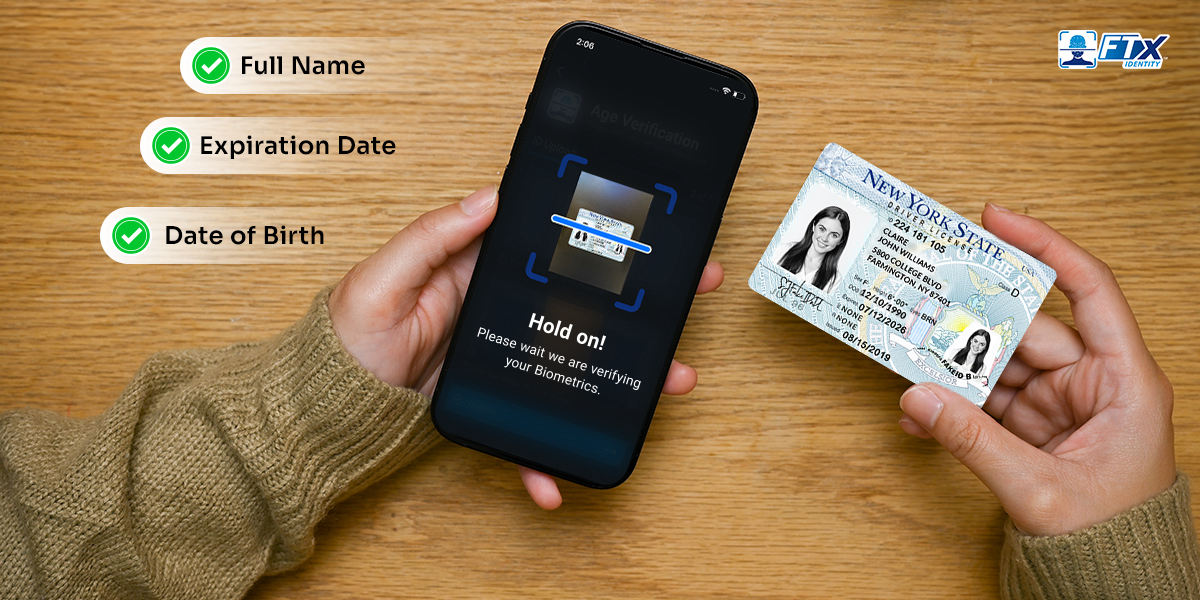
Say goodbye to manual data entry and hello to effortless onboarding! With FTx Identity’s OCR-powered data extraction, you can streamline your processes, reduce form abandonment rates, and stay compliant with global data privacy standards.
How It Works
Automated data extraction leverages several cutting-edge technologies like AI, OCR, and NLP to identify, retrieve, and process data efficiently.
- Optical Character Recognition (OCR): OCR converts text from physical documents, images, or PDFs into editable, digital data. This technology ensures highly accurate transcription, ideal for processing invoices, receipts, and contracts.
- Artificial Intelligence (AI) and Machine Learning (ML): AI and ML algorithms identify patterns in data to extract insights efficiently. They can learn and adapt over time, improving accuracy and functionality with each use.
- Natural Language Processing (NLP): NLP enables machines to understand and interpret text, whether it’s in emails, customer reviews, or handwritten notes. This opens opportunities for analyzing unstructured data.
Types of Data Extraction
For retailers, data isn’t just numbers – it’s the raw material for every smart decision you make. But not all data is created equal, and extracting it efficiently requires understanding its format. Automated data extraction solutions are designed to handle these different types, turning scattered information into structured, usable insights.
Let’s break down the three main types of data you encounter and how modern data extraction systems tackle them.
1) Unstructured Data
This is the most common and challenging format. Unstructured data has no predefined model or organization.
- Examples: Customer emails, social media comments, product reviews, handwritten notes, and the text within images or PDFs (like a photo of a driver’s license).
- The Challenge: For a person, it’s easy to read. For a simple system, it’s just a jumble of text. Extracting specific details (like a date of birth from an ID) requires intelligent parsing.
- The Solution: Modern automated data extraction software uses AI and natural language processing (NLP) to read, interpret, and pull out key information from these chaotic sources, transforming them into structured data.
2) Structured Data
This is the ideal, organized format that systems love. Data resides in fixed fields within a predefined schema.
- Examples: Database tables, spreadsheets, forms, and the barcode on a product. The data in your POS system’s inventory database is typically structured.
- The Process: Automated data capture from structured sources is highly efficient. Tools can directly pull information from specific fields (e.g., SKU number, price) without needing to interpret context, making automated data retrieval fast and accurate.
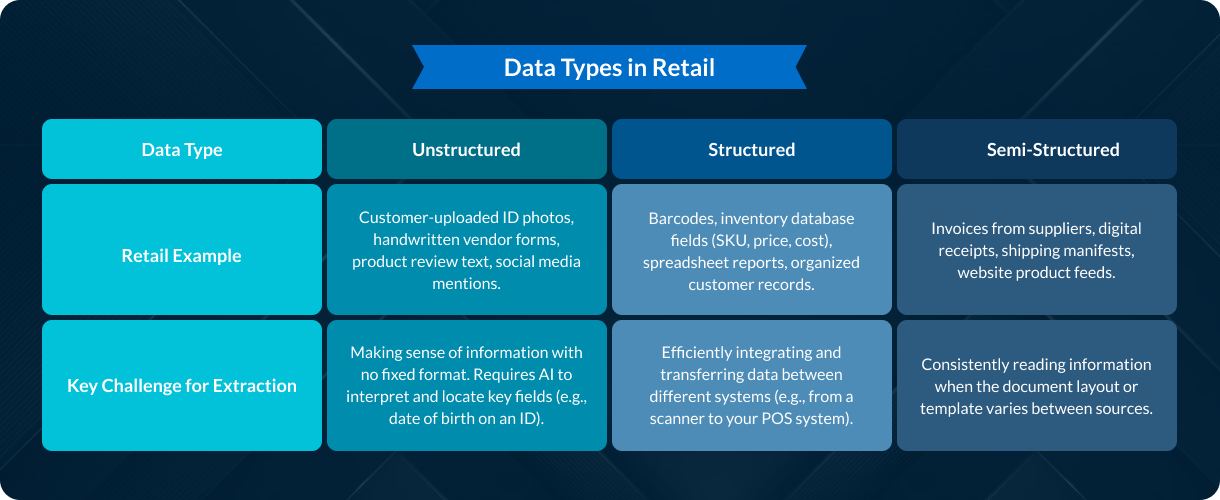
3) Semi-Structured Data
This type sits in the middle. It contains tags or markers that separate data elements but lacks the strict, table-like structure of a database.
- Examples: Invoices, receipts, HTML (HyperText Markup Language) web pages, and JSON (JavaScript Object Notation) or XML (eXtensible Markup Language) files.
- The Nuance: Extracting this data requires systems that recognize patterns and key-value pairs. Advanced data extraction methods can identify labels and pull the corresponding data, even if the document’s layout isn’t perfectly consistent.
Types of Retail Data That Can Be Extracted Automatically
For retailers, time spent manually typing information is time lost. Data extraction system turns this tedious task into a background process, capturing critical business information instantly and accurately. By leveraging automated data extraction software, you can unlock efficiency across every part of your operation. Here are the key types of retail data ripe for automation.
1) Product & Catalog Information
Manually entering thousands of stock keeping units (SKUs) is a nightmare. Automated data capture systems can pull product names, descriptions, UPC codes, and wholesale prices directly from supplier spreadsheets, portable document format (PDF) catalogs, or website feeds into your inventory management system, ensuring your data extraction system keeps your catalog perfectly synced.
2) Order & Transaction Documents
Every invoice and receipt contains vital data. An intelligent document reader can instantly scan these documents to extract invoice numbers, dates, line-item details, and final totals. This automatic data extraction feeds directly into your accounting software, reconciling payments and tracking costs without manual entry.
3) Vendor & Supplier Documents
Processing shipments and contracts is paperwork-heavy. Automated data retrieval from bills of lading, purchase orders, and supplier agreements captures key terms, delivery dates, and item quantities, streamlining your supply chain management and payment processes.
4) Inventory & Warehouse Data
Automated data capture transforms physical stock movements into real-time digital records—from barcode scans at receiving to cycle count sheets. This provides an accurate, up-to-the-minute view of stock levels directly within your data extraction solutions platform, reducing shrinkage and optimizing ordering.
5) Marketing & Customer Data
Understanding your customer is key. Automatic data extraction can pull contact information, purchase history, and preferences from warranty cards, website sign-ups, or loyalty program interactions. This builds rich customer profiles for targeted marketing campaigns.
6) Fraud & Compliance Documents
This is critical for age-restricted retail. Automated data extraction software is a game-changer for verifying government-issued IDs. It instantly reads and verifies names, dates of birth, and ID numbers, providing a secure automated data retrieval process for age verification and creating a reliable audit trail for compliance programs like EAIV (electronic age and identity verification).
Difference Between Data Extraction and Data Scraping
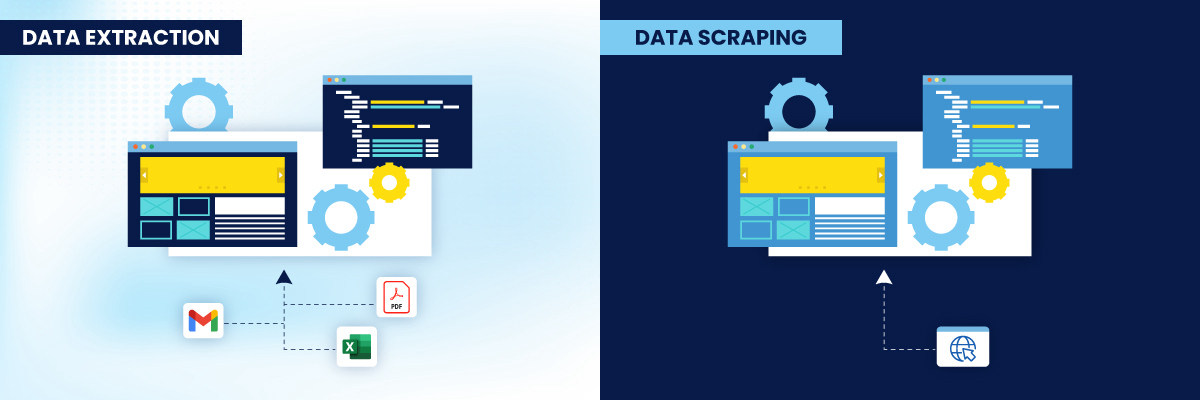
While often confused, data extraction and data scraping differ in their purpose and depth. Data extraction focuses on capturing meaningful data from various sources (emails, PDFs, reports). Data scraping, on the other hand, typically involves gathering publicly available data from websites, which may not always be structured or relevant for operational needs.
Common Pain Points in Retail Operations
Retailers face numerous challenges when managing vast amounts of data, and these pain points can significantly impact efficiency and decision-making.
Here are some of the most common issues:
- Manual Data Entry Errors: Typos, inconsistencies, and human mistakes often creep in during manual data entry. These errors can compromise the reliability of data, leading to flawed insights and decisions.
- Time-Consuming Processes: Many retailers spend countless hours manually entering and analyzing data. This time could be better spent on strategy, customer engagement, or improving other key operations.
- Inconsistent Formats: Data pulled from various channels – like online stores, physical locations, and third-party platforms – often comes in different formats. This makes it difficult to integrate and consolidate information into a usable format.
- Delayed Decisions: Slow data processing and analysis mean retailers can’t make quick, informed decisions in response to market trends or customer demands. This delay might result in missed opportunities or reduced competitiveness.
- Data Integrity Concerns: Without robust validation systems, retailers risk working with inaccurate or incomplete data. Poor data quality can lead to erroneous insights that negatively affect business outcomes, from forecasting to inventory management.
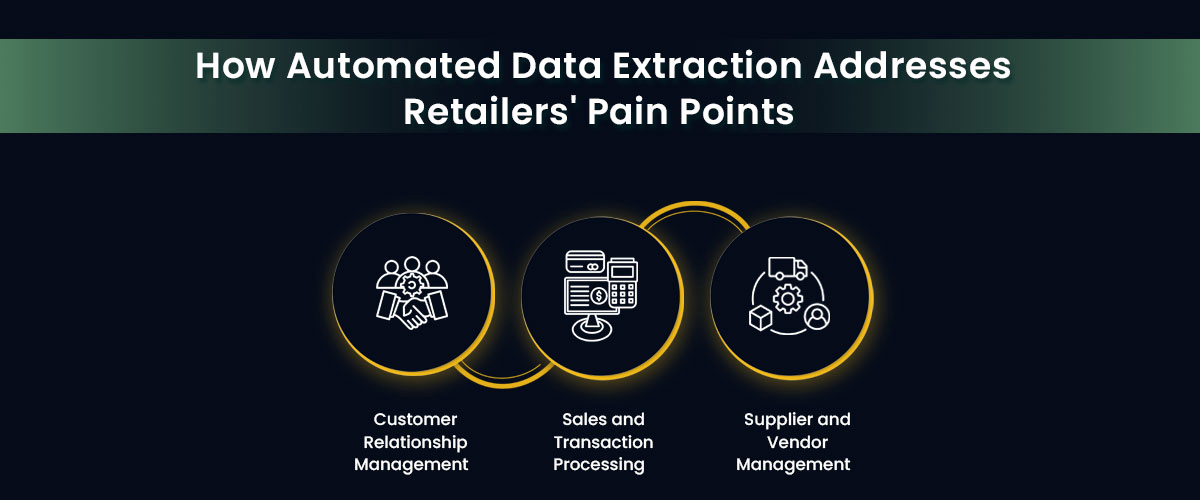
How Automated Data Extraction Addresses Retailers’ Pain Points
Retailers face numerous challenges in managing data, but a data extraction system offers transformative solutions to streamline operations and drive smarter decisions.
Customer Relationship Management
- Personalized Marketing: Harness data insights to craft tailored campaigns.
- Enhanced Service: Quickly retrieve purchase histories or preferences to resolve customer inquiries efficiently.
Sales and Transaction Processing
- Automate sales data processing to ensure every transaction is recorded accurately.
- Access real-time analytics to monitor sales performance and identify revenue opportunities.
Supplier and Vendor Management
- Seamlessly exchange data with suppliers, reducing errors in orders and communication.
- Efficiency in document handling keeps vendor relationships smooth and productive.
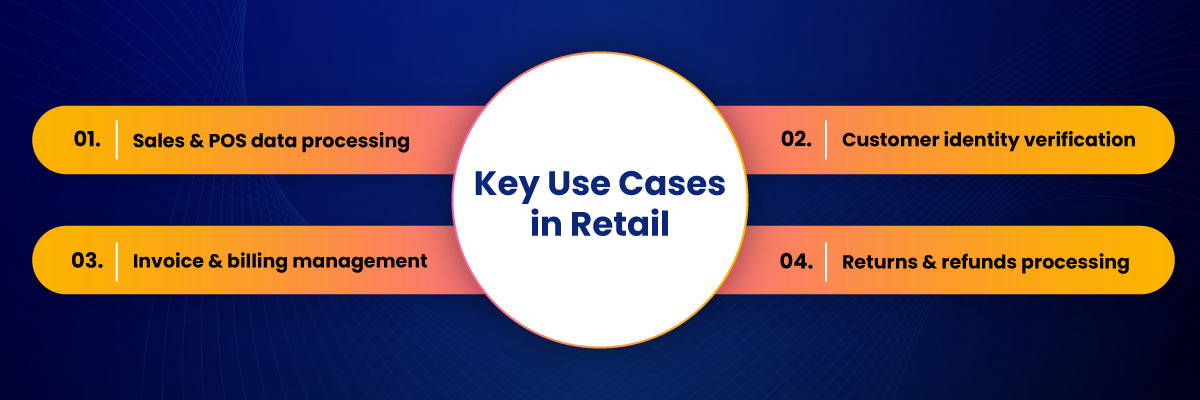
Key Use Cases in Retail
In retail, automation is unlocking new efficiencies by addressing common operational challenges. These key use cases highlight how automated data extraction methods streamline processes, reduce errors, and enhance the customer experience.
1. Sales & POS Data Processing: Prevent revenue loss and improve operational efficiency by eliminating incorrect manual entries at the point of sale. Automating data entry ensures accuracy and allows staff to focus on delivering better customer service.
2. Customer Identity Verification: Safeguard secure transactions with rapid verification processes that protect customer data and prevent fraud. These systems not only build trust but also ensure compliance with regulatory requirements.
3. Invoice & Billing Management: Streamline financial reconciliation and reduce errors with automated invoice sorting and tracking. By simplifying billing processes, retailers can save time and ensure timely payments, leading to better cash flow management.
4. Returns & Refunds Processing: Speed up dispute resolutions and create a smoother customer experience by automating returns and refunds. Efficient processing enhances customer satisfaction while reducing the workload for support teams.
Strengthen your security with advanced identity verification! Explore how FTx Identity’s AI-powered facial recognition and multi-stage verification processes can prevent fraud and ensure accurate, efficient verification. Protect your business and enhance customer trust with cutting-edge technology.
Learn more about Advanced Identity Verification!
Retail-Focused Features to Look for in Automated Data Extraction Tools
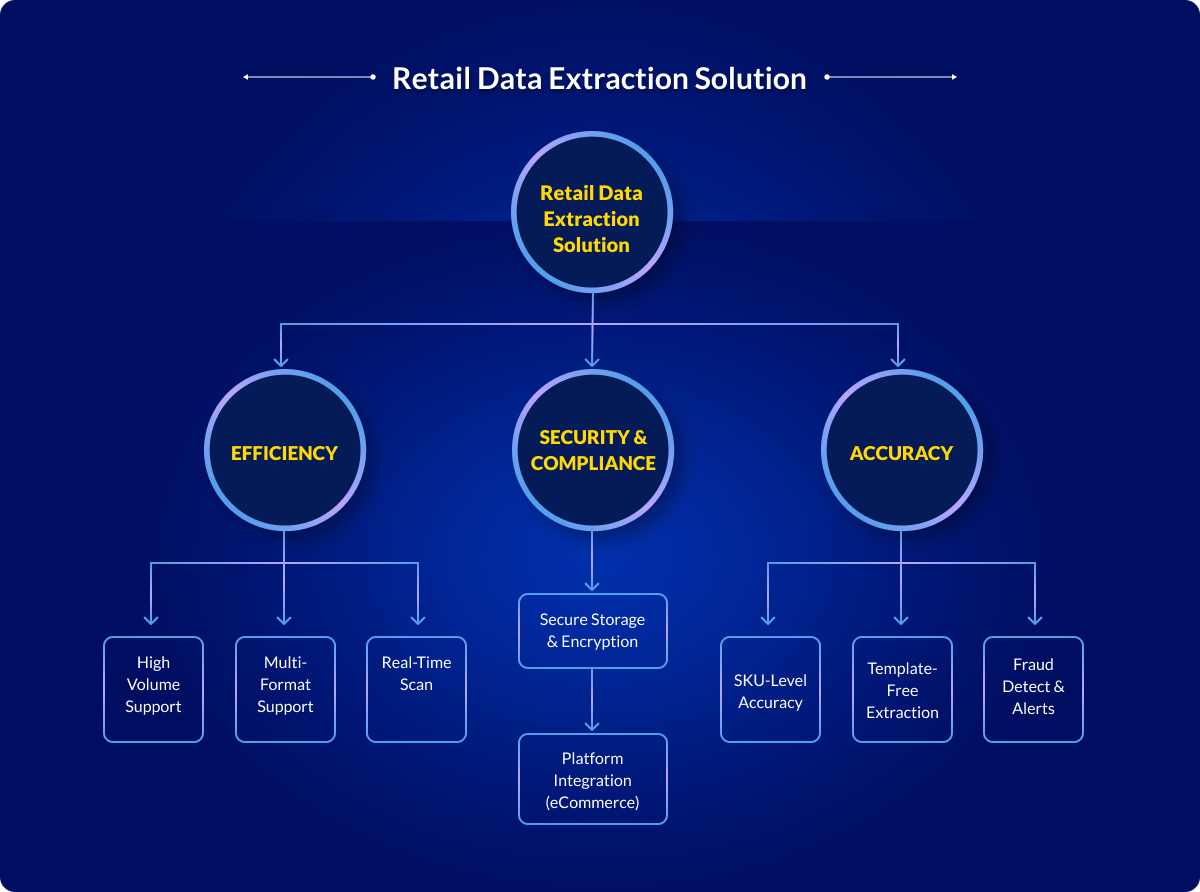
When evaluating data extraction solutions, you need features that match the unique volume, variety, and velocity of your business data. Here are the retail-centric capabilities that separate a basic tool from a game-changing investment.
1) Support for High Document Volumes
Your system must process hundreds of invoices, IDs, or shipping manifests daily without slowing down. Look for data extraction solutions built on scalable architecture that ensure consistent speed and reliability during peak business periods, turning high volume from a bottleneck into a non-issue.
2) Multi-Format Support (images, PDFs, spreadsheets)
Data comes at you from all directions. A robust data extraction system must handle smartphone photos of IDs, scanned PDF invoices from suppliers, and Excel inventory sheets with equal accuracy. This flexibility ensures no data source is a dead end for your automated data capture pipeline.
3) Integration with eCommerce Platforms (Shopify, Magento, WooCommerce)
Your online and offline operations must connect. The best automated data retrieval tools plug directly into platforms like Shopify, Magento, and WooCommerce, automatically syncing product details, customer orders, and inventory updates to create a single source of truth.
4) Secure Storage & Encryption
When extracting sensitive data like customer IDs or financial documents, security is non-negotiable. Ensure the automated data extraction software uses enterprise-grade encryption both for data in transit and at rest, protecting you and your customers from breaches and ensuring compliance with data protection regulations.
5) Fraud Detection & Error Alerts
A smart system should be a vigilant partner. Beyond just reading data, advanced tools cross-check information for inconsistencies, flag potential document tampering, and alert you to extraction errors in real-time. This is critical for preventing fraud in age verification and ensuring the accuracy of financial data.
6) Template-Free Extraction for Vendor Documents
You can’t force every supplier to use your template. Modern intelligent document readers use AI to understand the layout of any invoice or form without pre-set templates. This “template-free” automatic data extraction adapts to each vendor’s format, saving enormous setup time and maintenance.
7) Real-Time Receipt & Invoice Scanning
The value of data decays over time. The ability to scan a paper receipt or invoice at the counter or in the back office and have its data instantly digitized and categorized enables real-time inventory updates, instant expense reporting, and immediate reconciliation.
8) SKU-Level Accuracy
For inventory management, “close enough” isn’t good enough. Precision is paramount. Your chosen solution must deliver SKU-level accuracy, reliably distinguishing between variant codes (e.g., a product’s size or color SKU) to ensure your stock counts are perfect and your reorders are precise.
Retail-Specific Benefits of Automated Data Extraction
Investing in an automated data retrieval system goes beyond just buying software. For retailers, this technology delivers a powerful return by targeting the most time-consuming, error-prone, and critical tasks. These aren’t just IT improvements; they are concrete advantages that directly affect your efficiency, security, and bottom line.
1) Faster Onboarding
Whether it’s adding new products or verifying a customer’s age, speed is revenue. Automated data capture instantly pulls information from supplier sheets or government IDs, eliminating hours of manual entry. This means new inventory hits your shelves faster, and age-restricted sales proceed without frustrating delays at the checkout.

2) Accuracy Across Channels
Inconsistencies between your online store and physical inventory frustrate customers and cause overselling. Automated data extraction software ensures product details, pricing, and stock levels are synchronized with perfect accuracy across every sales channel, building trust and preventing costly errors.
3) Reduced Operational Costs
Manual data entry is a significant, hidden expense. By automating the extraction from invoices, receipts, and forms, you reclaim countless staff hours. This automatic data extraction allows your team to focus on high-value tasks like customer service and sales, directly lowering overhead and boosting productivity.
4) Improved Customer Experience
A smooth experience wins loyalty. Automated data retrieval enables seamless processes:
- Quick, accurate age verification for compliant purchases.
- Instant digital receipt generation.
- Faster loyalty program sign-ups using pre-filled data.
This reduces wait times and friction, making every interaction with your brand more positive.
5) Fraud Prevention & Compliance
This is a major advantage for regulated retail. An intelligent document reader does more than just scan an ID; it checks for authenticity, flags inconsistencies, and creates a verifiable audit trail. This robust automatic data extraction process is essential for preventing underage sales, meeting EAIV requirements for tobacco, and protecting against fraudulent returns or documents.
6) Enhanced Supplier Collaboration
Processing orders and invoices manually creates bottlenecks. With data extraction solutions, purchase orders, shipping notices, and invoices are digitized and validated the moment they arrive. This accelerates payment cycles, improves order accuracy, and builds stronger, more efficient relationships with your vendors.
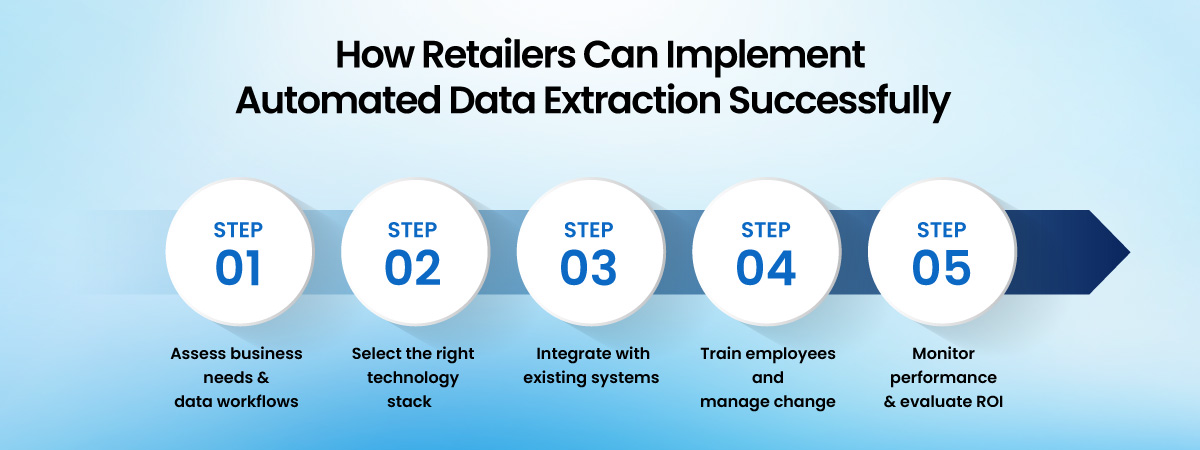
How Retailers Can Implement Automated Data Extraction Successfully
Implementing data extraction solutions requires a strategic approach to ensure success.
By following these key steps, retailers can seamlessly integrate automation into their operations and maximize its benefits:
Step 1: Assess Business Needs & Data Workflows
Start by carefully analyzing your current operations to pinpoint bottlenecks and inefficiencies that automation can resolve. Assess how data flows across departments and identify specific areas where automatic data extraction can save time, reduce errors, or improve decision-making. Involve stakeholders from different teams to ensure no critical aspect is overlooked.
Step 2: Select the Right Technology Stack
Choose technology solutions that align with your business’s unique requirements, including scalability, integration capabilities, and security protocols. Look for tools that can grow with your business, seamlessly integrate with multiple platforms, and comply with industry standards for data protection. Evaluate different providers through demos or trial runs to find the best fit.
Step 3: Integrate with Existing Systems
Successful implementation depends on how well the new automation tools work with your existing ecosystem. Ensure compatibility with essential systems such as your point of sale (POS), customer relationship management (CRM), enterprise resource planning (ERP), and accounting platforms.
Collaborate with IT teams to avoid disruptions and ensure smooth data transfer across platforms. Consider the need for application programming interfaces (APIs) or middleware solutions for seamless integration.
Step 4: Train Employees and Manage Change
Introducing new technology is only effective if your staff understands and adopts it. Provide thorough training sessions to ensure employees can confidently use the new tools. Address concerns and resistance to change by explaining how automation will simplify their tasks and improve efficiency. Regularly check in with teams during the transition to tackle any challenges they might face.
Step 5: Monitor Performance & Evaluate ROI
Once the automated data extraction system is live, track its performance against predefined benchmarks. Measure improvements in operational efficiency, time saved, error reduction, and overall cost-effectiveness. Regularly review metrics to ensure the system delivers value and make adjustments as necessary. A data-driven evaluation will also help you calculate return on investment (ROI) and justify the investment to stakeholders.
Overcoming Challenges in Implementing Automated Data Extraction
Implementing automated data capture comes with its share of challenges, but they can be effectively addressed with the right strategies. By tackling concerns around security, cost, and organizational change, retailers can pave the way for a successful transition
- Data privacy and security concerns: Ensuring that sensitive information is protected during data extraction is critical, especially with increasing regulations like the General Data Protection Regulation (GDPR) and the California Consumer Privacy Act (CCPA). Robust encryption and compliance measures are often required.
- Initial investment and ROI analysis: Implementing automated data extraction requires upfront costs for tools, software, and training. Organizations must carefully analyze the potential return on investment to justify these expenses.
- Managing change within the organization: Introducing new automated systems can disrupt existing workflows. It’s essential to provide proper training and address employee concerns to ensure smooth adoption.
- Ensuring compatibility with diverse data sources: Data often comes from various formats and platforms. Automated systems must be flexible enough to handle everything from PDFs and spreadsheets to APIs and unstructured data.
- Ensuring high accuracy and continuous system improvements: Automated data capture systems need fine-tuning to maintain accuracy. Regular updates and system monitoring are necessary to adapt to changing data patterns and improve performance over time.

Future Trends in Automated Data Extraction for Retail
The future of automatic data extraction in retail is set to revolutionize the industry with cutting-edge innovations. These emerging trends promise to enhance efficiency, security, and customer engagement like never before.
- AI-Powered Predictive Analytics: Harness the power of AI to analyze historical data and predict future trends, enabling businesses to develop actionable strategies and make smarter decisions.
- Real-Time Sentiment Analysis: Use advanced AI tools to analyze customer feedback as it happens, identifying emotions and sentiments to improve customer experiences and drive satisfaction.
- Biometric Identity Authentication: Enhance security and streamline user authentication with cutting-edge biometric technologies like facial recognition, fingerprint scanning, and voice verification.
- Hyper-Personalized Experiences: Utilize AI to deeply understand customer preferences and behaviors, delivering tailored recommendations and unique experiences that resonate on an individual level.
Upgrade your security with biometric authentication! Discover how FTx Identity’s cutting-edge features, like selfie-based ID validation and 3D liveness detection, can protect your business from fraud while simplifying identity verification. Enhance trust, streamline processes, and bring your security to the next level.
Conclusion: Why Now Is the Time to Automate Retail Data Processing
Automated data extraction is more than a tool; it’s a game-changing solution for retailers to operate smarter, faster, and more efficiently. By eliminating inefficiencies and empowering data-driven strategies, it provides a solid foundation for sustained growth. Now is the perfect time for retailers to evaluate their data workflows and adopt automated solutions.
Looking to get started? Integrate a data extraction system into your business processes and unlock the full potential of your data.
Get in touch with us at FTx Identity to schedule a consultation and experience a demo today!