





Cryptocurrency, once a niche market, has grown into a global financial phenomenon. With its expansion, the need for security and regulatory compliance has become increasingly important.
One of the foundations of this compliance is Know Your Customer (KYC) procedures.
What’s the significance of optimizing Know Your Customer (KYC) procedures within the cryptocurrency realm? This guide highlights the role played by ID technology in simplifying and enhancing this process. Additionally, we will provide valuable insights into practical strategies businesses can use to successfully integrate and execute KYC protocols, ensuring efficiency and compliance.
Understanding KYC for Crypto

KYC verification in crypto is particularly vital in combating money laundering, terrorist financing, and other illicit activities. To achieve this, crypto KYC requirements typically involve users providing:
- Personal Data: Essential details such as their full legal name and residential address.
- Government-Issued Identification: Official documents like passports or driver’s licenses to confirm their identity.
- Proof of Address: Supporting documents such as utility bills or bank statements to verify their stated address.
- Biometric Verification: Techniques like selfie or video verification to match the user to their submitted identification, ensuring they are the rightful owner.
The Challenges of Cryptocurrency Exchange Compliance

For cryptocurrency exchanges, staying compliant with ever-evolving regulations is a continuous challenge. Failure to do so can result in legal penalties and harm to their reputation. Therefore, crypto exchange operators must establish stringent KYC requirements for cryptocurrency users.
One ongoing problem in the industry is the presence of crypto exchanges that don’t require users to prove who they are before trading. While these platforms may attract users seeking anonymity, they often face regulatory scrutiny and potential legal consequences.
Why Crypto Businesses Can’t Afford to Skip KYC Verification
The days of crypto’s Wild West are over. Anyone still clinging to the notion that regulatory oversight is a distant threat is playing a dangerous game for their business’s future.
Regulatory expectations for crypto businesses have increased significantly. Platforms are expected to demonstrate accountability, transparency, and active measures to prevent illicit activity.
Strong KYC frameworks are central to building trust in digital finance. In practice, trust comes from verified identities and consistent fraud prevention measures—not assumptions.
Within crypto and other regulated sectors, digital identity verification is a key requirement for KYC/Anti-Money Laundering (AML) compliance. It supports accurate onboarding and continuous monitoring, helping platforms reduce risk and maintain regulatory alignment.
Your reputation is your currency in the crypto world. A single regulatory misstep, a single instance of being linked to illicit activity, can obliterate years of hard-earned trust. And in a space where news travels at the speed of light, that damage is often irreparable.
In essence, skipping KYC isn’t a risk; it’s a self-inflicted wound. It’s a gamble with your reputation, your legal standing, and ultimately, your business’s very existence. The message is clear: embrace KYC, or prepare to face the consequences.
Leveraging ID Technology for Efficient Crypto KYC

Efficiency in KYC procedures is critical for both businesses and users. Leveraging ID technology can significantly enhance the user experience while ensuring compliance.
Here’s how businesses can benefit from implementing ID technology in their crypto KYC processes:
Automation and Speed
Efficiency in KYC procedures is crucial for both businesses and users. By implementing ID technology, businesses can automate the crypto KYC process.
This allows users to complete identity verification swiftly, reducing waiting times for account approval.
Automating the process not only makes it faster but also reduces the chance of human mistakes in manual checks, making the user experience better. The allure of quick digital onboarding can attract more users to the platform, enhancing its growth and competitiveness.
Enhanced Security
Security is paramount in the world of cryptocurrency, and ID technology plays a pivotal role. By using advanced methods like document verification and using biometrics (like fingerprints or facial recognition), ID technology makes sure that the information users provide is accurate and reliable.
This enhanced security reduces the risk of fraudulent activities, maintains the platform’s integrity, and enhances overall user confidence. Businesses can safeguard against counterfeit documents and unauthorized access, providing a secure environment for cryptocurrency transactions.
Scalability
As the cryptocurrency market continues to expand, businesses need to adapt and accommodate a larger user base efficiently. ID technology simplifies this process by enabling seamless scaling of KYC procedures.
In a fast-growing market, businesses can manage more verifications efficiently without sacrificing the security or compliance of their platform.
Additionally, ID technology facilitates compliance with evolving regulatory standards, ensuring that KYC procedures remain up-to-date and aligned with industry best practices.

User Convenience
Providing a user-friendly experience is paramount for cryptocurrency platforms. Efficient KYC procedures significantly contribute to the overall user experience. Users appreciate platforms that offer streamlined onboarding processes, as they can quickly complete the KYC process.
The quicker and smoother onboarding is, the more likely users are to engage with the platform. This leads to increased customer satisfaction and loyalty, ultimately making platforms more competitive in the cryptocurrency industry. Platforms that prioritize user convenience stand out as user-friendly and trustworthy, further enhancing their reputation in the crypto ecosystem.
KYC Requirements for Cryptocurrency Businesses
While specific KYC requirements for this type of business may vary based on jurisdiction and regulatory changes, certain common elements exist.
Here are aspects businesses should consider:
Identity Verification
Cryptocurrency businesses typically require users to provide government-issued identification like passports or driver’s licenses. This data is crucial for confirming the user’s identity and complying with regulations. ID technology is crucial in this process, as it swiftly and accurately confirms the legitimacy of these documents, reducing the need for manual work and boosting security.
Proof of Address
Proof of address documents, such as utility bills or bank statements, serve to confirm a user’s residence. This helps prevent fraudulent activity and ensures compliance. ID technology expedites this process by swiftly proofing these documents, reducing delays in the onboarding process.
Enhanced Due Diligence

For high-risk transactions or substantial fund transfers, enhanced due diligence is necessary. This may involve additional identity checks and verification of the source of funds. ID technology can automate these processes, ensuring comprehensive due diligence while maintaining efficiency.
Ongoing Monitoring
Cryptocurrency businesses must implement continuous monitoring to detect suspicious activities and adhere to evolving regulations. ID technology can help in this by continuously analyzing user behavior and transaction patterns, promptly flagging any anomalies, and ensuring ongoing compliance with regulatory changes.
Travel Rule Compliance
The Financial Action Task Force (FATF) Travel Rule requires platforms to share sender and recipient information for certain transactions. For businesses, this means your KYC in crypto setup must go beyond basic checks and support data sharing between entities.
A strong crypto KYC process ensures accurate user identification, while a reliable KYC solution for crypto platforms helps you stay compliant without slowing down transactions.
Cost of Non-Compliance
In crypto, skipping proper checks isn’t a small mistake—it’s a business risk. Without a solid KYC in crypto setup, the consequences hit fast and hard.
Heavy Fines
Regulators don’t go easy on violations. Missing crypto KYC requirements can lead to massive financial penalties.
Mandatory Audits and System Fixes
Non-compliance often triggers forced audits. Platforms are pushed to upgrade their KYC systems for crypto compliance under pressure.
Service Suspension
Regulators can halt operations until proper KYC verification processes are in place.
Loss of Banking Partners
Banks avoid high-risk platforms. Weak KYC for cryptocurrency practices can lead to account closures.
Market Makers Pulling Out
Liquidity providers won’t stay if compliance is shaky. A poor cryptocurrency KYC process signals risk.
Delisting Threats
Exchanges and partners may delist assets linked to non-compliant platforms lacking a reliable compliance framework.
Frozen Credit Lines
Access to funding can be restricted if your KYC for crypto controls aren’t up to standard.
Potential Asset Seizure
In serious cases, authorities can freeze or seize assets due to failed KYC in crypto compliance.
Severe Reputational Damage
Trust is everything. Weak crypto KYC providers or poor processes can damage your brand overnight.
High Risk of Collapse for Smaller Platforms
Smaller platforms face a high risk of collapse if they fail to meet KYC requirements in crypto. Non-compliance can be enough to force them to shut down operations entirely.
Can You Do a Crypto Exchange Without KYC?
Yes, trading crypto without KYC is possible, but it depends on the platform you choose. Some cryptocurrency exchanges do not require users to undergo identity verification and allow for anonymous trading. However, as mentioned, such non-KYC crypto exchanges often face regulatory scrutiny and may impose limitations on the amount and type of transactions users can conduct.

How KYC Works in Crypto
KYC in cryptocurrency works similarly to traditional financial ID verification methods. Users provide personal information and documentation to verify their identity. This information is cross-referenced with various databases to ensure its accuracy. ID technology plays a pivotal role in simplifying this process by automating document verification and reducing the time required for KYC checks.
DeFi, Stablecoins, and the KYC Frontier
As crypto evolves, compliance is getting more complex. Whether it’s decentralized finance (DeFi) or stablecoins, KYC in crypto is becoming increasingly expected across more areas of the ecosystem.
KYC for DeFi Platforms
DeFi was built to be decentralized, but regulators are catching up. Platforms are now expected to introduce KYC for crypto measures to reduce risk and meet evolving crypto KYC requirements.
Stablecoin KYC Requirements (e.g., GENIUS Act)
Stablecoins are facing increasing regulatory attention under emerging frameworks such as the Guiding and Establishing National Innovation for U.S. Stablecoins (GENIUS) Act.
These developments reflect a broader push for clearer oversight of reserve backing, issuer responsibilities, and compliance standards, including identity verification requirements for participating platforms.
Cross-Chain & On-Chain Compliance
With assets moving across chains, tracking users becomes harder. That’s where advanced KYC crypto solution providers step in—helping enforce cryptocurrency KYC process standards across multiple networks.
The Problems KYC Solves for the Crypto Industry
The crypto industry, while brimming with innovation, faces a unique set of challenges that necessitate robust KYC measures. It’s not just about ticking boxes; it’s about building a foundation of trust and security in a space still grappling with its identity.
Meeting Jurisdictional Compliance Standards:
KYC regulations in crypto differ across jurisdictions, requiring businesses to stay adaptable as they navigate evolving global compliance requirements.
Defending Against Social Engineering Attacks:
The digital nature of crypto makes it a prime target for social engineering. From phishing scams to impersonation, the risks are real. Crypto identity verification is the first line of defense, ensuring that users are who they claim to be, mitigating the damage caused by these manipulative tactics.
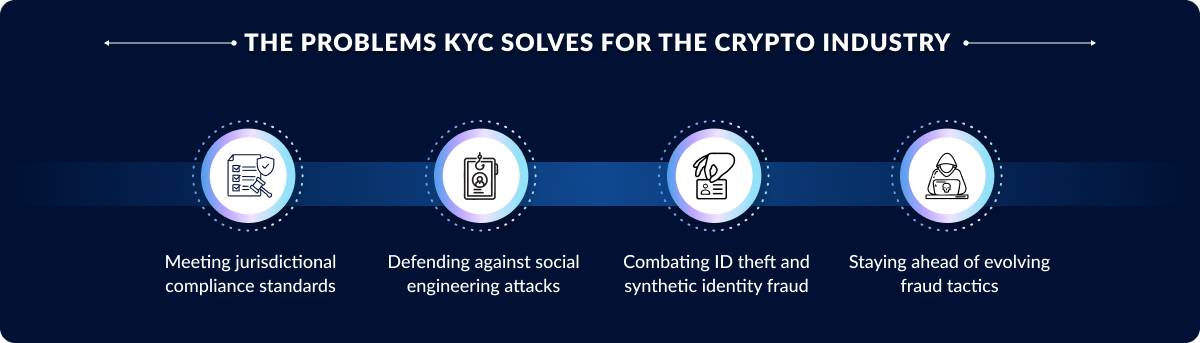
Combating ID Theft and Synthetic Identity Fraud:
The anonymity that once defined crypto is now a double-edged sword. Criminals exploit this, creating synthetic identities or stealing real ones to facilitate illicit activities. A comprehensive identity verification for cryptocurrency systems, therefore, is essential to halt these practices.
Staying Ahead of Evolving Fraud Tactics:
Fraudsters are relentless, constantly evolving their tactics. To stay ahead, crypto businesses need dynamic solutions. This involves continuous monitoring and adaptation to new threats, ensuring the platform remains secure.
Benefits of Crypto KYC
Implementing crypto KYC procedures offers numerous benefits to both businesses and users:
Enhanced Security
Implementing crypto KYC procedures significantly bolsters the security of cryptocurrency platforms. These procedures act as a robust defense mechanism against unauthorized access and potentially fraudulent activities.
By verifying user identities through KYC, platforms ensure that only legitimate individuals have access to their accounts. This, in turn, reduces the risk of fraud and theft, creating a safer environment for users to engage in cryptocurrency transactions with confidence.
Regulatory Compliance
Cryptocurrency businesses must adhere to KYC requirements to remain compliant with evolving regulations. Failure to do so can lead to severe legal consequences, including hefty fines and potential shutdowns.
Following KYC rules is not merely a choice but a necessity in order to keep the cryptocurrency world safe and trustworthy. It also fosters a regulatory environment where cryptocurrencies can coexist with traditional financial systems, facilitating their broader adoption and acceptance.
Trust and Credibility

Trust is paramount in the cryptocurrency industry, and businesses that prioritize KYC procedures gain a substantial advantage in this regard. Users are more likely to trust and engage with platforms that demonstrate a commitment to trustworthiness and transparency through strict KYC measures.
This trust-building process enhances customer loyalty, contributing to the long-term success and sustainability of cryptocurrency businesses. Ultimately, it positions these businesses as reliable and credible participants in the competitive crypto landscape.
Reduced Risk
KYC procedures serve as a crucial risk mitigation strategy for cryptocurrency platforms. By verifying user identities, businesses can effectively minimize the risk of money laundering, fraud, and other illicit activities on their platforms.
These procedures act as a deterrent, making it significantly more challenging for malicious actors to engage in illegal activities within the cryptocurrency realm.
Consequently, KYC not only safeguards the platform but also protects the interests of all users and investors, contributing to a safer and more trustworthy crypto environment.
Essential Tools and Features for Effective Crypto KYC
Effective KYC in crypto demands a sophisticated toolkit. It’s not enough to simply ask for an ID; modern solutions need to delve deeper.
ID Selfie and Liveness Verification:
These technologies go beyond simple ID checks. They ensure the person is physically present, preventing spoofing and deepfake attacks. This is a critical component of secure crypto verification.

Digital Footprint Analysis:
Analyzing a user’s digital footprint provides valuable insight into behavior and authenticity. Identifying anomalies can help detect fraudulent activity and strengthen crypto identity verification processes.
Device Intelligence:
Understanding the device used for transactions is crucial. Device intelligence can detect suspicious patterns, such as multiple accounts using the same device or unusual device settings.
Blockchain ID Validation:
Leveraging the immutability of the blockchain for ID validation adds an extra layer of security. This technology creates a tamper-proof record of user identities, enhancing trust and transparency. ID verification for cryptocurrency platforms can benefit greatly from this technology.
Significance of KYC for Crypto Exchanges
KYC is extremely important for crypto exchanges. It helps exchanges maintain regulatory compliance, prevent illegal activities, and build trust with users. Failing to implement effective KYC procedures can result in legal consequences and damage the exchange’s reputation, potentially leading to its shutdown.
Are There Crypto Exchanges Without KYC?
Yes, there are crypto exchanges that do not require KYC verification. These platforms cater to users who value anonymity and privacy in their cryptocurrency transactions. However, users should exercise caution when using non-KYC crypto exchanges, as they may face limitations on withdrawal amounts and could potentially encounter legal issues if the platform faces regulatory scrutiny.
How to Implement KYC: Step-by-Step for Crypto Businesses
Setting up KYC in crypto isn’t just about ticking boxes—it’s about building a process that works daily without slowing users down.

Risk Assessment
Start by identifying your risk level—user types, regions, and transaction volumes. This defines how strict your crypto KYC requirements need to be.
Select a Jurisdiction-Appropriate Framework
Different regions have different rules. Your KYC for cryptocurrency setup should align with local regulations to avoid compliance gaps.
Build Your Document + Biometric Verification Flow
Combine document verification with biometric checks, such as facial recognition, to strengthen identity verification in crypto onboarding while keeping the process smooth for users.
Integrate Wallet Screening
Screen wallets for suspicious activity and sanctions. This strengthens your KYC crypto solution beyond just identity checks.
Set Up Ongoing Monitoring
KYC isn’t one-time. Continuous checks help maintain compliance as user behavior changes within your cryptocurrency KYC process.
Document Everything
Keep detailed logs of every step. A reliable crypto KYC service ensures you’re always audit-ready and protected.
Wrapping Up
Efficient cryptocurrency KYC procedures are essential for businesses operating in the crypto space. Leveraging ID scanning technology not only streamlines onboarding but also enhances security and ensures compliance with crypto exchange regulations.
As the crypto industry continues to evolve, businesses that prioritize efficient KYC procedures stand out as trustworthy and reliable platforms in the eyes of users and regulators alike. Implementing and optimizing KYC requirements for cryptocurrency is not just a regulatory necessity but a strategic advantage in the competitive world of cryptocurrency exchanges.
To sum it up, efficient KYC procedures are a win for both businesses and users, and they play a crucial role in preserving the cryptocurrency ecosystem’s integrity.
Don’t Let Compliance Slow You Down
Automate KYC, accelerate onboarding, and secure your
platform’s future with FTx Identity!