





Running a liquor store comes with a simple expectation that carries serious weight: you have to verify age—every time, without exception.
It’s not just a policy. It’s part of protecting your license, your staff, and your business overall.
Most retailers already know this. That’s why many rely on an ID scanner for liquor stores to speed things up at the register. Scan the barcode, confirm the birthdate, move on.
On the surface, it feels solid. Efficient, even. It creates consistency across staff and shifts, especially in busy environments where speed matters.
But what that process is really doing is checking data—not verifying identity.
And that’s where a lot of compliance issues quietly start—because everything appears to be working until it isn’t.
In this blog post, we’ll break down how barcode scanning actually works, where it falls short in real-world retail environments, and why modern age verification for liquor stores requires more than a single scan at the register.

What Is an ID Scanner for Liquor Stores?
An ID scanner for liquor stores is a tool used at checkout to read and interpret information from a customer’s identification—typically a driver’s license or state-issued ID.
In day-to-day operations, it’s often positioned as a quick checkpoint: scan the ID, confirm the age, and proceed with the sale.
In retail environments, these systems are often used as part of the age verification process, but their capabilities can vary significantly depending on the technology behind them.
Broadly speaking, there are two types:
- Basic barcode scanners that simply read encoded data from the ID
- Advanced liquor store ID verification systems that analyze the document itself and detect fraud indicators
A basic system focuses on speed and data capture—getting information into the system quickly and accurately.
A more advanced system focuses on authenticity, consistency, and fraud detection—helping answer a deeper question: does this ID actually hold up?
The key distinction is simple: one reads what’s printed, the other evaluates whether it should be trusted.
With layered checks beyond traditional barcode scanning, it brings more confidence to every sale.
See how it supports stronger compliance and smoother operations.
Understanding How Barcode Scanning Works in Retail
Barcode scanning is widely used in liquor stores because it’s fast and easy to integrate into checkout workflows. It reduces friction at the register and helps standardize how age checks are handled across different employees.
But to understand its limitations, it helps to break down what’s actually happening behind the scan—and what’s not.
1. What Information a Barcode Actually Contains
Most U.S. driver’s licenses use a PDF417 2D barcode on the back of the card.
That barcode contains encoded text such as:
- Name
- Date of birth
- Address
- License number
- Expiration date
At first glance, that sounds comprehensive—and in many ways, it is helpful information.
But importantly, this is not live or verified data.
It’s simply a digital representation of what was printed when the ID was issued.
That means:
- It does not update in real-time
- It is not connected to a government database during scanning
- It can be copied from one ID and replicated onto another
So when a scanner reads it, it is only confirming that the data exists—not that the ID is legitimate or currently valid.
That distinction is easy to overlook, especially when the scan result appears clean and immediate.
2. Why Liquor Stores Adopt Barcode Scanners
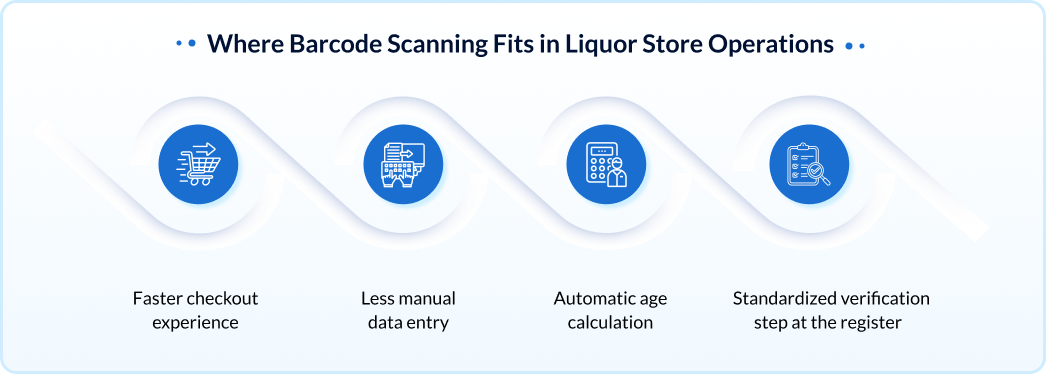
Despite their limitations, barcode scanners are popular for a few very practical reasons:
- Faster checkout experience
- Less manual data entry
- Automatic age calculation
- Standardized verification step at the register
In a busy retail environment, those efficiencies matter. They help reduce lines, improve customer flow, and give staff a consistent process to follow.
The challenge is that convenience often gets mistaken for completeness. Many systems built as “assistive tools” end up being treated as full verification solutions.
Over time, the scan becomes the decision point—rather than one step within a broader verification process.
When Barcode Scanning Fails: Real Scenarios Liquor Stores Face
Barcode scanning works well in ideal conditions—but real-world retail isn’t ideal. It’s fast-paced, unpredictable, and often reliant on split-second decisions.
Here are common scenarios where barcode-only verification can fall short.
The “Borrowed ID” Problem
A customer presents a legitimate, valid ID—but it doesn’t belong to them.
The barcode scans successfully. The date of birth checks out. The system approves the transaction.
But the person standing at the counter is not the ID owner.
Without an additional layer of verification, there’s nothing in the scan itself that prompts a second look.
takes priority over deeper verification. Learn more about how FTx Identity supports liquor stores.
The “Barcode Generator” Threat
Modern counterfeit IDs have become more sophisticated.
Some fake IDs now include generated barcodes that match the printed information on the front of the card.
So, when scanned:
- The data aligns
- The age appears valid
- The system passes the ID
Everything looks consistent at a glance, which makes it easy for these IDs to move through a basic scan without disruption.
The “Out-of-State ID” Confusion
Each state issues IDs with subtle differences in:
- Layout design
- Barcode formatting
- Security elements
- Update cycles
Basic liquor store ID scanners may not consistently recognize or flag these variations, especially as states update their formats over time.
As a result, inconsistencies can slip through—particularly in stores that regularly see out-of-state customers.
Staff Turnover and Compliance Gaps
Technology is only as strong as the process around it.
Liquor stores often face:
- High employee turnover
- Varying training levels
- Busy, high-pressure environments
- Over-reliance on scanning shortcuts
Over time, barcode scanning becomes a “check-the-box” step instead of a real verification process.
That’s where compliance gaps form—not from intent, but from inconsistency in how the process is applied.
manipulation, it’s worth seeing how modern systems are adapting . Explore why businesses
are moving beyond basic ID scanning toward more advanced fraud detection.
Business Risks of Non-Compliance Due to Basic Scanning Tools
Relying solely on barcode scanning doesn’t just create operational weaknesses—it introduces real regulatory exposure over time.
Heavy fines and license suspension
Selling alcohol to underage customers can result in:
- Significant fines
- Temporary shutdowns
- Suspension or loss of liquor licenses
What often gets overlooked is how quickly these penalties escalate. In many jurisdictions, even a single violation can shift a store into a higher-risk category, triggering increased oversight or more frequent inspections moving forward. It’s not just the immediate penalty—it’s the longer-term impact on how the business is monitored.
Liability for staff and store owners
Compliance responsibility doesn’t sit in one place—it extends across the business and everyone involved in the sale.
That can include:
- Store owners who oversee compliance policies
- Managers responsible for training and enforcement
- Employees handling day-to-day transactions
In practice, this means that inconsistent execution at the register can become a business-level issue. Even when there’s no intent to bypass procedures, gaps in process or training can still lead to accountability concerns.
Having a clear, repeatable verification workflow helps ensure everyone is operating from the same standard—not individual judgment calls during a busy shift.
Insurance and compliance impacts

Regulatory issues don’t just stay within licensing—they often influence how a business is evaluated financially over time.
Potential outcomes include:
- Higher insurance premiums
- Increased audit frequency
- Stricter underwriting requirements
Insurers and regulators tend to look at patterns, not isolated events. If a store is flagged for compliance issues, it can change how risk is assessed moving forward—even if operations improve later.
What Effective Age Verification Should Look Like
Real compliance doesn’t rely on a single check—it uses multiple layers of verification working together to validate both the ID and the person presenting it.
Barcode scanning alone is designed to read information. Effective verification is designed to confirm legitimacy.
ID Scanning with Document Authentication
Advanced systems don’t just read the ID—they evaluate the document itself as a physical object.
This can include checking:
- Material structure and overall card quality
- Print precision, spacing, and layout consistency
- Embedded or built-in security features
This step shifts the process from simple data capture to document-level validation, helping ensure the ID itself aligns with expected standards before any data is accepted.
OCR (Optical Character Recognition) Verification
OCR adds another layer by comparing what’s printed on the ID with what’s encoded in the barcode in real-time.
When the system detects differences—whether in spelling, formatting, or data structure—it creates a point of review for further inspection.
This matters because even small inconsistencies between visible and encoded information can indicate issues that aren’t immediately obvious during a quick scan or visual check.
UV, Infrared, and Hologram Detection
Modern IDs are designed with multiple embedded security features that are difficult to replicate accurately.
These may include:
- Ultraviolet (UV)-reactive elements that only appear under specific lighting conditions
- Infrared-readable markings embedded into the card design
- Layered holographic patterns that shift or change under viewing angles
Advanced scanning systems can detect these features in seconds, adding a validation layer that doesn’t depend on what the eye can see under normal conditions.
Database Cross-Referencing
Some systems are able to compare ID data against trusted databases or verified record sources when available.
This can help confirm whether key identity details align with authoritative records or expected formats, adding an external point of validation beyond the physical document itself.
While not used in every transaction, this layer becomes especially useful when additional confirmation is needed as part of a broader verification process.
Facial Recognition and Biometric Matching
In higher-assurance environments, systems may compare the photo on the ID to the live image of the person presenting it.
This helps confirm that the individual using the ID is the rightful owner, rather than relying solely on document data.
It adds an identity-level check that supports the document verification process and strengthens overall confidence in the match between person and ID.
POS-Integrated Age Verification Systems
When verification is fully embedded into the point-of-sale (POS) system, it becomes part of the transaction itself rather than a separate step.
In this setup:
- Every alcohol sale automatically triggers an ID check
- The process cannot be bypassed during checkout
- Verification is applied consistently across all transactions
This kind of integration helps standardize execution across staff and shifts. Instead of relying on individual judgment or remembering procedures in busy moments, the system ensures the same verification flow is followed every time.
barcode scanning and manual checks. Learn more about how automated identity verification
uses multi-layer checks to improve security and compliance at checkout.
How Liquor Stores Can Build a Reliable Age Verification System
Strong compliance doesn’t come from a single tool or feature—it comes from a system where multiple safeguards work together in a consistent, repeatable way under real store conditions.
The goal isn’t just to verify IDs when things are going smoothly. It’s to create a process that holds up across busy shifts, new employees, and high-pressure checkout environments.
Invest in Proper ID Scanning Hardware
Not all ID scanners offer the same level of verification capability, and that difference matters more in day-to-day use than most retailers realize.
When evaluating hardware, look for systems that go beyond simple barcode reading and include:
- Document authentication capabilities
- Multi-layer fraud detection
- Built-in security feature validation
The key shift here is moving from data capture to document evaluation. In other words, the system shouldn’t just be reading what’s on the ID—it should be helping assess whether the ID itself is legitimate.
Integrate with Your POS System
Age verification is most effective when it’s not treated as an optional step or a separate tool—it needs to be part of the actual checkout flow.
When properly integrated into the POS system:
- Every alcohol transaction automatically triggers verification
- There’s less reliance on memory or manual prompts
- Staff follow a consistent, built-in process regardless of experience level or shift volume
This kind of integration helps reduce variation in execution, which is often where small compliance gaps start to form over time.
Train Staff Rigorously and Regularly
Even with strong technology in place, consistency ultimately comes down to how the system is used in real-world situations.
Effective training should reinforce a few core principles:
- Barcode scanning is only one step in the verification process
- Visual inspection of the ID still plays an important role
- Anything unusual, unclear, or inconsistent should be escalated rather than rushed through
The objective isn’t to slow down transactions—it’s to give staff a clear, repeatable framework for making decisions confidently, even during peak hours.
Maintain Detailed Compliance Records
Modern verification systems can automatically log key activity across transactions, including:
- ID scan attempts
- Verification outcomes
- Transaction history tied to compliance checks
These records aren’t just useful for audits—they also provide visibility into how the system is actually performing over time. Patterns in flagged IDs, overrides, or exceptions can highlight areas where training or process adjustments may be needed.

Conduct Internal Compliance Audits
Regular internal reviews help ensure the system in place is working the way it’s intended— not just in theory, but in everyday store conditions.
These audits typically focus on:
- Whether verification procedures are being followed consistently
- How often exceptions or workarounds occur
- Whether staff are fully utilizing the tools available to them
Approached proactively, this becomes less about enforcement and more about maintaining alignment across teams before small inconsistencies turn into larger issues.
Stay Updated on State-Specific Regulations
Age verification requirements aren’t uniform—they can shift based on state, local jurisdiction, and licensing type.
For liquor retailers, that means staying current with:
- State-level compliance laws and updates
- Local enforcement expectations and trends
- Any changes tied to licensing or regulatory guidelines
Because regulations evolve over time, the systems supporting compliance need to evolve with them. What works today should still be evaluated tomorrow to ensure it continues meeting current requirements.
Conclusion
A liquor store ID scanner is a valuable tool—but it is not a complete verification system when it relies solely on barcode scanning.
Barcode data confirms what is printed. It does not confirm authenticity, identity, or in integrity.
Modern compliance requires more than speed. It requires layered verification that includes document authentication, fraud detection, and consistent POS integration.
Because in the end, the goal isn’t just to scan IDs quickly.
It’s to make sure every single sale is defensible, compliant, and secure.
Go Beyond Barcode Scanning
See how FTx Identity adds layered verification—so you’re not just scanning IDs,
you’re confidently verifying every sale.