



With the rise of online shopping and digital transactions, retailers face the challenge of delivering fast, seamless customer experiences while staying compliant with regulations for age-restricted products. Today’s consumers expect interactions that are not only efficient but also secure and privacy-conscious.
In this blog post, we’ll break down how age estimation and age verification work, their benefits and challenges, and how retailers can use them to protect their business while keeping customers happy.
What Is Age Estimation?
Age estimation is a digital technique that predicts a customer’s approximate age without requiring an official ID. It’s primarily used to streamline the shopping experience for products that may or may not be strictly regulated.
How Age Estimation Works

In digital retail, speed and convenience matter, but retailers still need to assess customer age responsibly. Age estimation offers an automated way to approximate age without slowing the shopping process. While not a replacement for formal age-based verification, it works well for non-regulated products.
AI & Computer Vision
Facial age estimation often relies on AI algorithms and computer vision, analyzing images or videos to predict a person’s age based on facial features. These systems can process thousands of images quickly, allowing retailers to identify likely age ranges in real-time.
Behavioral Indicators
Some solutions enhance accuracy by looking at behavioral parameters, such as browsing patterns, time spent on certain content, device type, and transaction history. These subtle cues help the system make more informed predictions while remaining unobtrusive.
Face Analysis
Facial analysis examines specific characteristics like wrinkles, bone structure, and skin texture to estimate age. Advanced systems adjust for lighting, angle, and image quality to improve predictions and minimize errors.
Why Age Estimation Matters
Age estimation offers several benefits that make it appealing for retailers looking to balance customer experience, privacy, and operational efficiency.
Fast and Frictionless
Customers can move through online stores quickly without delays from manual ID checks, creating a smoother and more enjoyable shopping experience. This seamless approach helps maintain engagement and reduces the risk of abandoned carts.
Privacy-Preserving
Because no personal documents are stored or shared, customers’ sensitive information remains protected. Retailers can maintain trust and privacy standards, reassuring shoppers that their data is handled responsibly.
Higher Conversion Rates
Reducing friction at checkout encourages more completed purchases, helping retailers boost sales and improve overall revenue. A faster, more convenient process keeps customers satisfied and more likely to return.
Lower Cost
Automated age estimation reduces the need for additional staff or manual verification processes. This not only lowers operational expenses but also streamlines workflows, allowing resources to be allocated more efficiently.
Less Staff Effort
Employees spend less time manually verifying age, freeing them to focus on other customer service tasks. This improves efficiency both in-store and online, ensuring staff can deliver a better overall experience.
Helpful for Non-Regulated Scenarios
Age estimation is especially useful for products that aren’t strictly regulated but benefit from general age-appropriate recommendations. Examples include age-targeted marketing, content restrictions, or product suggestions for certain age groups, helping retailers provide a tailored experience.
Challenges and Risks in Age Estimation
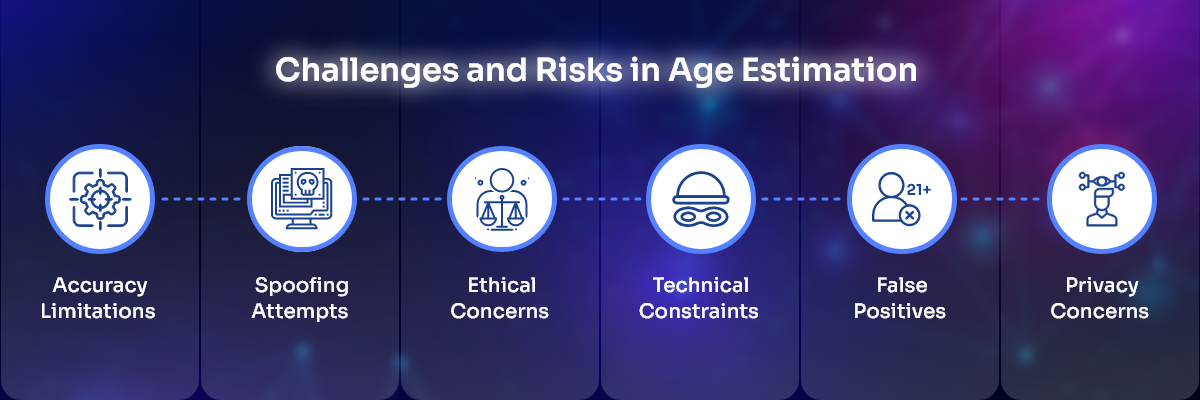
While age estimation is useful, it’s not without limitations.
Retailers should be aware of potential risks and challenges:
Accuracy Limitations
AI-based predictions aren’t perfect. Individuals near age thresholds may be misclassified, which can impact both compliance and customer experience. Retailers need to recognize that age estimation provides an approximate range rather than a definitive verification.
Spoofing Attempts
Systems that rely on photos or videos can be vulnerable to fraud, such as fake images or digitally manipulated content. This means there’s always a risk that someone could attempt to bypass the system.
Ethical Concerns
Automated age assessments raise important questions about fairness and bias. Factors like ethnicity, facial features, and lighting can influence predictions, so it’s crucial for retailers to understand the limitations of AI models.
Technical Constraints
Practical issues such as hats, masks, sunglasses, or poor lighting can interfere with facial analysis. These constraints can reduce accuracy or require multiple attempts to get a usable reading.
False Positives
There’s always a chance that the system could incorrectly classify a minor as an adult—or an adult as a minor. Retailers should be aware of this possibility and consider backup verification methods in sensitive scenarios.
Privacy Concerns
Scanning facial or behavioral data involves handling sensitive information. Retailers must maintain transparency, clearly communicate how data is used, and comply with privacy regulations to preserve customer trust.
What Is Age Verification?
Age verification is a formal process that confirms a customer’s actual age, usually by checking official ID documents or using digital age verification solutions. Unlike estimation, it is legally recognized for regulated products.
How Age Verification Works
Ensuring that age-restricted products reach only eligible customers is critical for both compliance and safety. Age verification provides a reliable way to confirm a customer’s age, combining technology and secure processes to protect retailers and shoppers alike.
ID Document Scanning
Customers provide an official document, such as a driver’s license, passport, or government-issued ID. The system quickly verifies the authenticity of the document, checking for features like holograms, expiration dates, and other security elements to ensure it’s legitimate.
Face Matching / Biometric Confirmation
To add another layer of security, the customer’s face is compared against the ID photo. This biometric check confirms that the person presenting the ID is truly its owner, reducing the risk of fraud or misuse.
Database Checks
Age verification systems may also cross-reference government or trusted private databases to validate the ID and confirm that the customer information is current and accurate. This step adds another safeguard against fraudulent or outdated documents.
Decision: Approval / Denial
Once all verification steps are complete, the system provides a clear decision: approval allows the transaction to proceed, while denial blocks it. This ensures that only eligible customers can purchase age-restricted products.
Advantages of Age Verification
Age verification offers a range of benefits for retailers, from regulatory compliance to operational efficiency.
Meets Legal Requirements for Age-Restricted Retail
Verification ensures compliance with laws governing alcohol, tobacco, and other regulated products, helping retailers avoid violations.
Significantly Reduces Underage Fraud
By confirming a customer’s identity, age verification lowers the risk of minors gaining access to restricted items, protecting both the retailer and the broader community.
Provides Auditable Compliance Logs
Detailed records of verification activity make inspections, audits, and reporting straightforward, giving retailers peace of mind during regulatory reviews.
Higher Trust from Regulators and Brands
Accurate and reliable verification strengthens credibility with regulators, suppliers, and brand partners, demonstrating a commitment to responsible sales practices.
Safety from Penalty or Fines
Proper age verification helps retailers avoid legal consequences and fines, reducing risk while maintaining compliance.
Faster Checkout
Automated verification speeds up the purchasing process, letting customers complete transactions quickly without unnecessary delays.
Store Operational Efficiency
With verification handled digitally, staff can focus on customer service and other key tasks, saving time and resources while improving overall operations.
Challenges and Risks in Age Verification
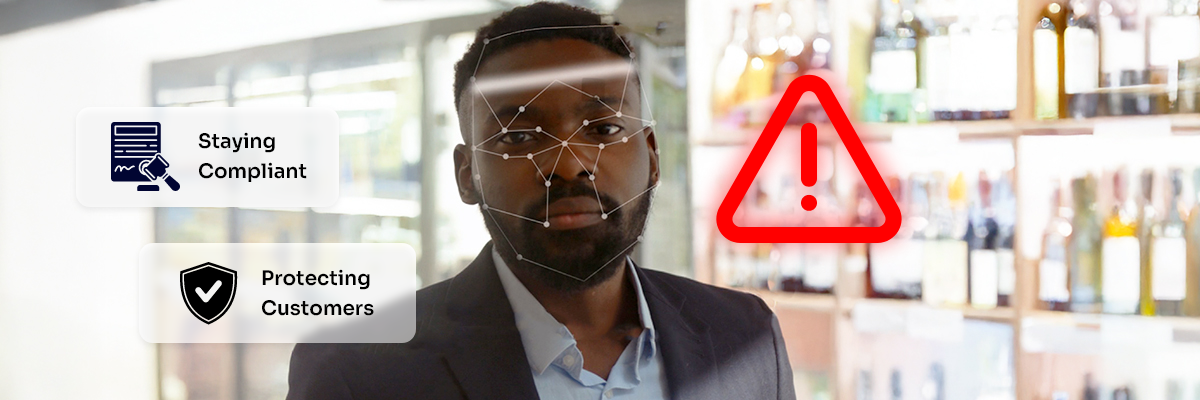
Age verification is essential for protecting customers and staying compliant, but it can come with some practical challenges that retailers should be aware of.
Customer Friction & Drop-Off
Asking customers to provide ID or go through verification steps can slow down the checkout process. In some cases, it might even cause shoppers to abandon their purchase, especially in fast-paced retail or online environments.
Privacy & Trust Issues
Handling personal information like IDs or other documents can make customers cautious. Maintaining transparency and protecting sensitive data is key to building trust.
High Operational Costs
Manual verification can be time-consuming and costly. Extra staff time, training, and administrative work all add up, especially for businesses with high transaction volumes.
Regulatory Compliance Complexity
Laws and regulations around age-restricted products are always evolving. Keeping up-to-date and ensuring your processes meet legal requirements can be tricky, requiring careful attention and ongoing management.
Where Age Verification Fits in Retail
Age verification isn’t just a legal checkbox—it’s a tool that helps retailers run smarter, safer operations.
Some of the key applications include:
High-Risk Product Sales
Age verification is essential for the sale of tobacco, alcohol, and other regulated products. By confirming a customer’s age before purchase, retailers can ensure compliance with the law and reduce the risk of selling to minors.
Online Retail Checkout
Age verification in ecommerce ensures legal compliance without disrupting the digital shopping experience. Automated verification allows customers to complete their purchase quickly, while retailers stay protected from potential violations.
Delivery Driver Workflows
For products delivered to customers, age verification helps ensure secure and compliant handoffs, giving retailers confidence that deliveries are handled responsibly while protecting everyone involved in the process.
Compliance & Audit Requirements
Retailers can maintain detailed, audit-ready records of age verification activity. This simplifies inspections, reporting, and regulatory audits, giving businesses confidence that they are meeting legal obligations.

Fraud Prevention
Automated age verification reduces the risk of underage purchases and identity fraud. By confirming both age and identity, retailers can prevent fraudulent transactions and protect their brand integrity.
How FTx Identity’s Age Verification Software Helps Retailers
FTx Identity turns age verification into a fast, secure, and cost-effective process while addressing all the concerns retailers usually have:
Low Monthly Cost & Pay-Per-Verification
Retailers only pay for approved verifications, meaning denied attempts are free. Re-verifications are easy since the customer’s information is securely stored in the backend.
Simplifies Onboarding
Customers are verified in just 1–2 minutes, ensuring a smooth, frictionless experience.
Complete Data Security
Only name and age verification status are visible to staff. Sensitive personal details like addresses or ID numbers remain fully encrypted and inaccessible, even in-store.
Always Up to Date
The software automatically stays current with the latest regulations, keeping your business compliant without extra effort.
AI-Assisted Validation
FTx Identity uses intelligent AI to assess submitted documents, automatically detecting inconsistencies, errors, or signs of tampering. This ensures each verification is accurate and reliable, without manual intervention.
Liveness & Biometric Authentication
Our software performs real-time biometric checks to confirm that the customer is physically present and actively participating. This prevents spoofing or fake submissions while keeping the verification process quick and seamless.
Conclusion
Age estimation and age verification each serve distinct purposes. Estimation can enhance user experience and speed for low-risk scenarios, while verification ensures legal compliance for regulated products. Retailers must balance compliance, customer experience, privacy, and risk, and tools like FTx Identity make that balance achievable.
Compliance, speed, and privacy—all in one solution.
Reach out today to see FTx Identity in action and schedule your consultation and demo.