



The world of retail is constantly moving, and it holds true for the tobacco industry. We’re seeing a significant growth in tobacco ecommerce, driven by a rising demand for premium and alternative products. This guide is designed to help you channel the tobacco industry, explaining exactly how to start your online tobacco business while staying fully compliant with all regulations.
It’s crucial to understand from the outset: age verification is not optional – it’s the foundation of any compliant tobacco store. Getting this right is essential for avoiding legal risks and building trust with your customers.
Non-compliance with tobacco age verification laws can cost brands more than just reputation. It can lead to heavy fines, legal penalties, and even the suspension or loss of tobacco sales licenses for retailers.
Can You Sell Tobacco Online?
Before you even think about setting up your shop, you need to grasp the legalities. While this guide focuses primarily on the U.S. legal landscape, it’s worth noting that regulations vary significantly across the globe.
In the U.S., you’ll encounter a maze of rules:
- Federal regulations: The PACT Act (Prevent All Cigarette Trafficking Act) and various Food and Drug Administration (FDA) rules are non-negotiable. They govern everything from product labeling to shipping restrictions.
- State-specific laws: This is where things get truly complex. Each state has its own set of rules regarding online tobacco sales, licensing, and taxation. What’s legal in one state might be prohibited in another.
- Age restrictions: Selling tobacco to minors is strictly forbidden, and enforcement is getting stricter. You need robust systems to ensure every customer is of legal age.
- Shipping restrictions: Carriers like USPS, FedEx, and UPS have their own rules, many of which prohibit or heavily restrict the shipment of tobacco products, especially to consumers. Understanding these limitations is critical for fulfillment.
Many of the legal requirements for shipping tobacco are similar to those for selling vapes online. It’s crucial to be aware of these restrictions to avoid potential legal issues.
Planning Your Business
A solid plan is your blueprint for success. Don’t rush this stage.
- Choose your niche: The tobacco market is vast. Will you focus on cigars, chewing tobacco, vapes, or accessories? Specializing can help you stand out.
- Define your target market and product range: Who are you selling to? What specific products will appeal to them?
- Understand licensing and permits: Beyond federal rules, you’ll need to secure the necessary business licenses and tobacco permits at the state and local levels. This can be a lengthy process, so start early.
- Competitive research and market differentiation: Look at what established online tobacco shops are doing. What can you do better? How will your online tobacco store stand out?

Legal Requirements to Start an Online Tobacco Business
Selling tobacco online is lucrative and heavily policed. Before you scale, lock the legal basics in place so compliance doesn’t become your weakest link.
Business Licensing
Every jurisdiction has its own licensing rules. Many states require a tobacco retail license for businesses that sell to consumers, and some localities add municipal permits on top. Apply early: licenses often take weeks to process and can require proof of a physical business address, owner IDs, and tax registration documents.
Tobacco Retailer Registration
If you plan to ship interstate, federal registration and reporting may be required under the PACT Act. That means more than a signature. There are reporting, labeling, and delivery obligations that trigger criminal penalties for serious violations. Don’t assume, “I’ll cross that bridge later.” Register and comply from day one.
State and Local Permits
Local rules can be unexpectedly strict: zoning restrictions, bans on sales near schools, local vendor registries, cross-border sales restrictions, or special health department permits for certain products. Check municipal code and state statutes before listing inventory.
Tax Compliance
Tobacco taxes vary dramatically by product and by state. You’ll likely need to remit excise or sales taxes to the destination state or collect proof of tax paid by the purchaser. Missing tax filings is one of the fastest ways to lose money and attract enforcement.
Shipping Compliance
Shipping tobacco is not the same as shipping T-shirts. Carriers and postal services have distinct rules and, for some products, absolute prohibitions. Find carrier approvals and packing/labeling rules before listing any product.
Age Verification Compliance
Federal and state law sets a minimum purchase age (21 in the U.S.), and regulators expect robust, layered age checks. On-site ID checks, third-party age verification, and age-gated delivery are common requirements. Recent FDA guidance also tightens ID checks for younger adults.
Record-Keeping Requirements
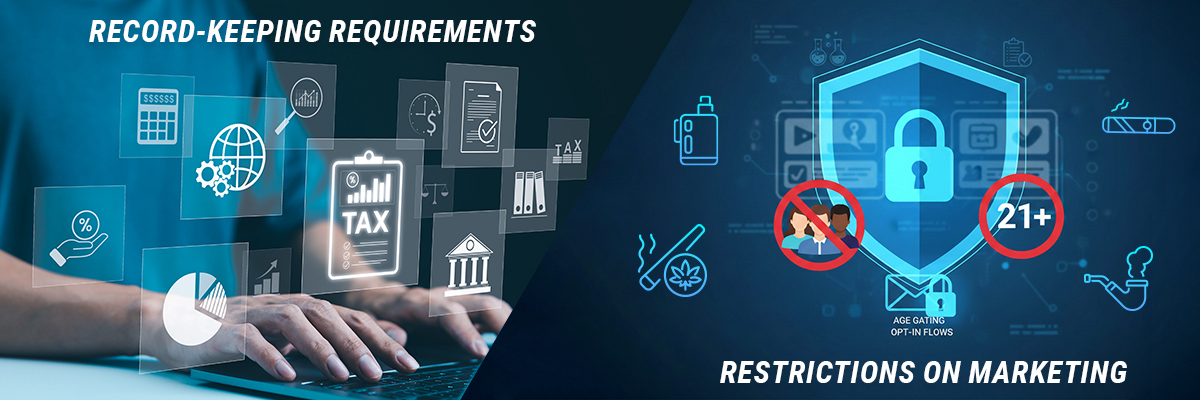
You will need detailed transaction logs: who bought what, proof of age verification, shipping records, and tax-related documentation. The PACT Act and related regulations mandate specific record formats and retention windows. Plan your data model and backups accordingly.
Restrictions on Marketing
Advertising tobacco is limited: no targeting youth (under 21), no free sampling in most cases, and strict rules around health claims. Digital ads should avoid platforms that ban tobacco promotion outright; email and direct marketing still require careful age gating and opt-in flows.
Tobacco Products You Can Sell Online
Not every tobacco item you can imagine is treated the same in law or by carriers. Here’s a practical breakdown.
Cigarettes
High regulation, high tax. Many carriers refuse cigarette shipments. Interstate sales of cigarettes are subject to PACT Act registration and reporting. If you list cigarettes, expect the heaviest compliance burden.
Cigars
Cigars are often treated differently: depending on the carrier and postal rules, they may be mailable where cigarettes are not. Still, state rules and taxes apply. Declare them properly for customs on any international orders.
Vape & E-Cigarette Products
E-cigarettes and Electronic Nicotine Delivery Systems (ENDS) require careful age verification and may fall under both FDA and PACT Act oversight. Nicotine-containing liquids and devices trigger extra scrutiny, especially around labeling and ingredient reporting.
Smokeless Tobacco
Chewing tobacco, snuff, and similar products are explicitly covered by PACT Act restrictions and face strict mailing rules. Treat them like cigarettes when you design compliance workflows.
Pipe & Hand-Rolling Tobacco
Often classified as “smokeless” or loose tobacco variants, these products carry the same strictures as other tobacco substitutes. Roll-your-own (RYO) components are also regulated and can trigger PACT compliance.
RYO Tobacco
Roll-your-own materials are watched closely. Where allowed, they require the same reporting, taxation, and record-keeping as other tobacco products under the federal law.
PACT Act Compliance Checklist
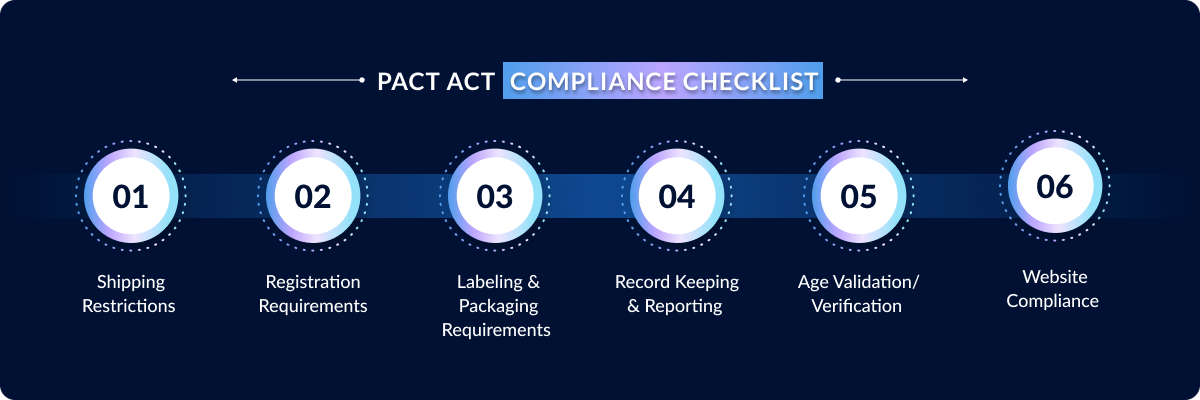
If you sell or ship cigarettes or smokeless tobacco across state lines, PACT Act rules control large parts of what you must do. Treat this checklist as mandatory reading.
Shipping Restrictions
The PACT Act regulates shipments through the U.S. Postal Service and imposes rules on other carriers. Some products cannot be mailed internationally or to military addresses. Treat USPS rules as binding.
Registration Requirements
Sellers who advertise and ship cigarettes or smokeless tobacco in interstate commerce must register with federal authorities and report to state tax administrators. Expect to provide seller details, locations shipped to, and frequency of shipments.
Labeling & Packaging Requirements
Labels must be accurate and include required warnings; packaging often must meet tamper-evidence standards. The Act includes obligations for package marking and statements so that regulators and carriers can identify contents.
Record Keeping & Reporting
Maintain searchable logs of sales, date of sale, purchaser name, address, and proof of age. Keep shipping manifests and carrier confirmations. Regulators will ask for them during audits.
Age Validation/Verification
PACT requires rigorous age verification at the point of sale and upon delivery. Use third-party age verification that can be audited and retains proof of ID checks. Digital self-attestation isn’t enough.
Website Compliance
Your website must include appropriate age gates, clear tobacco warnings, and terms that show your registration and tax compliance. Disclose shipping limits and carrier policies clearly to limit disputes and chargebacks.
How to Ship Tobacco Products Legally
Shipping tobacco is an operational compliance discipline.
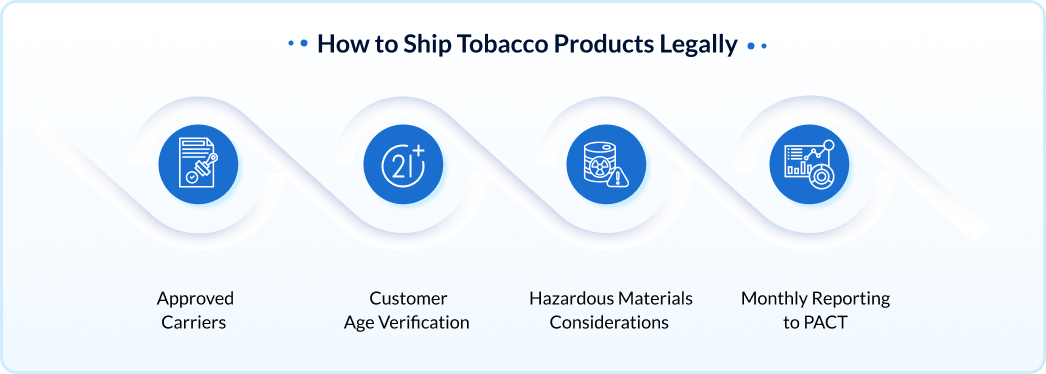
The following are the methods to ship tobacco legally.
Approved Carriers
Not all carriers will accept tobacco. FedEx, for example, generally prohibits tobacco shipments through retail locations; UPS accepts tobacco only from licensed, pre-approved shippers and under tight conditions; USPS has its own specific mailing rules, and many carriers restrict international shipments. Confirm the carrier policy in writing and keep approval documents on file.
Customer Age Verification
Protect your business with a two-step approach: verify age online at checkout and confirm ID upon delivery or with signature-required shipping. Use services that require ID at receipt and securely store verification logs to stay compliant.
Hazardous Materials Considerations
Some e-liquids and batteries are classified as dangerous goods. Packaging must meet hazardous shipment rules; failing to label properly can cause carrier refusal or fines.
Monthly Reporting to PACT
Sellers must submit regular reports to states and the Bureau of Alcohol, Tobacco, Firearms and Explosives (ATF). Build reporting automation into your fulfillment pipeline — manual reports are error-prone and put you at risk.
How to Run a Smooth Online Tobacco Store
Compliance is baseline. Operational excellence is what grows repeat business and keeps regulators happy.
Inventory Management
Track product provenance, lot numbers, and tax stamps where applicable. Integrate inventory with your online catalog so out-of-stock items can’t be ordered and tax calculations update by destination.
Order Fulfillment
Design fulfillment workflows for compliance: age-check at checkout → review by staff → pack with compliance labels → ship with approved carrier + adult signature. Use fulfillment checklists so no step gets skipped during busy periods.
Customer Service
Train customer service reps to handle age disputes, returns, and chargebacks without admitting liability. Keep canned responses that document verification steps taken; those notes often settle disputes quickly.
Fraud Prevention
Tobacco sales are a high-fraud category (chargebacks, stolen cards, reship requests). Use AVS checks, CVV checks, velocity rules, and device fingerprinting. Also, align payment modes to tobacco-specific processors when possible.
Building a Compliant Ecommerce Store
Your ecommerce platform is the backbone of your business. While popular options like Shopify, WooCommerce and BigCommerce are great, they often have limitations or outright restrictions for high-risk products like tobacco.
When building your site, key compliance features are a must:
- Secure checkout: Protect customer data with Secure Sockets Layer (SSL) encryption.
- Legal disclaimers: Clearly state age requirements, shipping restrictions, and other legal notices.
- Privacy and data handling policies: Be transparent about how you collect and use customer information.
- Integrated age verification software: This isn’t just a pop-up; it needs to be a robust system verifying age before purchase.
For better conversions and trust, focus on UX design that is intuitive, mobile-friendly, and clearly communicates compliance. Our age verification software integrates easily into most major ecommerce platforms, making setup a breeze and ensuring you’re always compliant.
Why Age Verification Is the Cornerstone of Tobacco Ecommerce
Age verification for tobacco sales is crucial. It’s not just about following the law; it’s about ensuring that you’re promoting responsible consumption. Various methods can be used for age verification, including credit card verification and third-party services.
- Legal consequences: Selling to minors, even inadvertently, can result in hefty fines, business shutdowns, and severe legal repercussions.
- Customer experience: Poor verification processes can frustrate legitimate adult customers, leading to cart abandonment and negative reviews. Imagine having to upload your ID every time you buy a product!
- Manual checks: Relying on customers to upload IDs is cumbersome and significantly increases cart abandonment rates. It’s slow, intrusive, and prone to errors.
- Speed: Instant verification means a smooth, fast checkout process.
- Legal compliance: Ensures you’re always meeting federal and state age restrictions.
- Trust and transparency: Shows customers you’re a responsible seller, building confidence in your brand.

The benefits of automated, real-time age verification are undeniable:
Marketing Tobacco Products Online (Legally)
Marketing tobacco products online requires creativity and strict adherence to regulations, as many traditional advertising channels are banned.
- Search engine optimization (SEO) content marketing: Invest in valuable content like blogs, product reviews, and detailed product guides to attract organic traffic. Use keywords like “online tobacco sales” and “selling cigars online” naturally.
- Email marketing: Build age-gated email lists and send targeted promotions. This is one of your most effective direct marketing channels.
- Influencer marketing: Collaborate with adult influencers who cater to your target demographic, ensuring they disclose partnerships and adhere to age restrictions.
- Banned channels: Avoid relying on Facebook/Google ads, as these platforms typically prohibit tobacco advertising.
- Loyalty programs and subscriptions: Encourage repeat business with exclusive discounts and convenient subscription box options.
Scaling Your Business
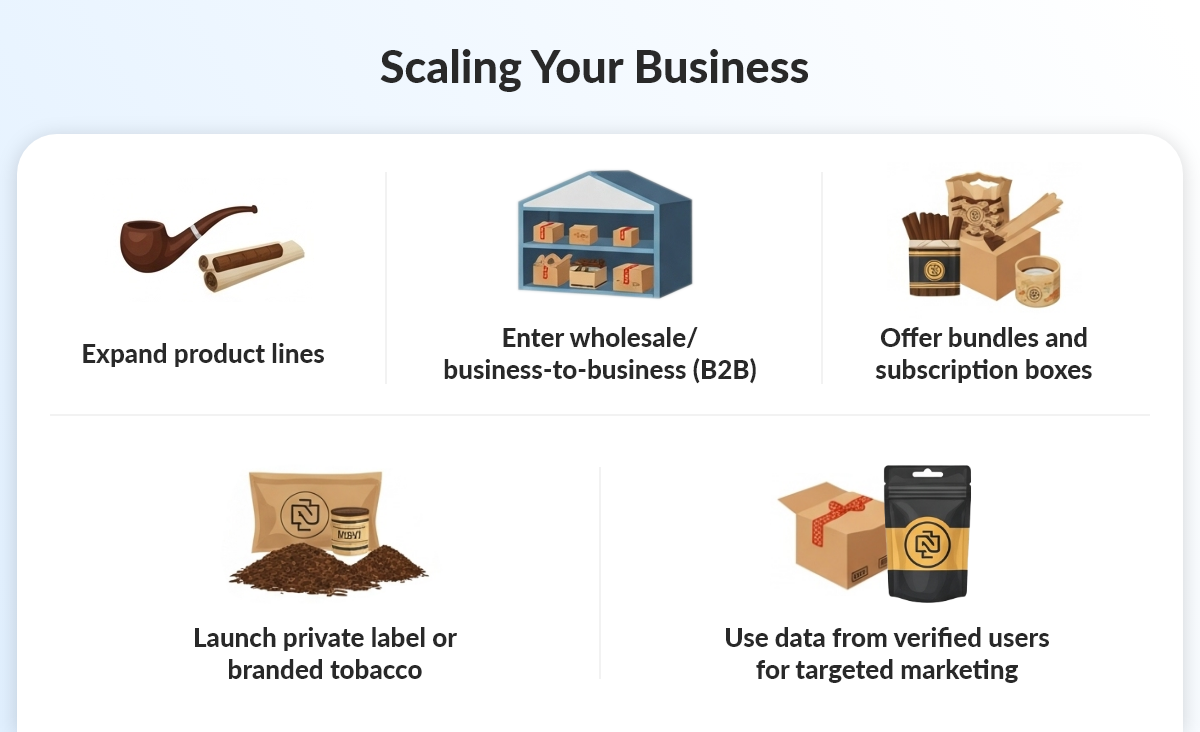
Once your initial online tobacco shop is established, look for opportunities to grow:
- Expand product lines: Introduce new types of tobacco, accessories, or even related non-tobacco products.
- Enter wholesale/business-to-business (B2B): Supply other retailers or businesses.
- Offer bundles and subscription boxes: Increase average order value and customer loyalty.
- Launch private label or branded tobacco: Develop your own unique product lines.
- Use data from verified users for targeted marketing: Leverage insights from your age verification system (while respecting privacy laws) to personalize marketing efforts.
Common Mistakes to Avoid
Starting an online tobacco business is complex. Avoid these pitfalls:
- Ignoring regional compliance rules: Laws vary dramatically by state and even county. Thorough research is paramount.
- Using unsupported payment/shipping platforms: This can lead to frozen accounts, payment processing issues, or legal trouble. Seek out ecommerce solutions for smoke shops designed for your industry.
- Skipping age verification or relying on manual methods: This is the quickest way to face legal action and lose customer trust.
- Overcomplicating the checkout experience: A cumbersome checkout leads directly to abandoned carts.
- Not researching local/state laws before launch: Crucial for avoiding legal issues.
- Skipping tax registration and filing requirements: Tobacco products are subject to specific excise taxes.
Is your business prepared for compliance?
Avoid costly penalties by ensuring hassle-free, accurate age verification online. Let’s talk about keeping your business safe and compliant!
Remember, proper age verification online for tobacco sales significantly reduces both legal and financial risks.
Conclusion
Selling tobacco online offers a lucrative opportunity, but it’s undoubtedly risky without the right tools and strategies. Success hinges on a deep understanding of the legal landscape and unwavering commitment to compliance.
Age verification is not just a legal formality – it builds trust. It demonstrates your commitment to responsible sales, protecting both your business and your customers.
Don’t Risk Fines. Build Your Online Tobacco Store With Confidence.
From age verification to PACT Act compliance, we make sure your entire ecommerce flow is airtight
so you can focus on sales—not stress.