


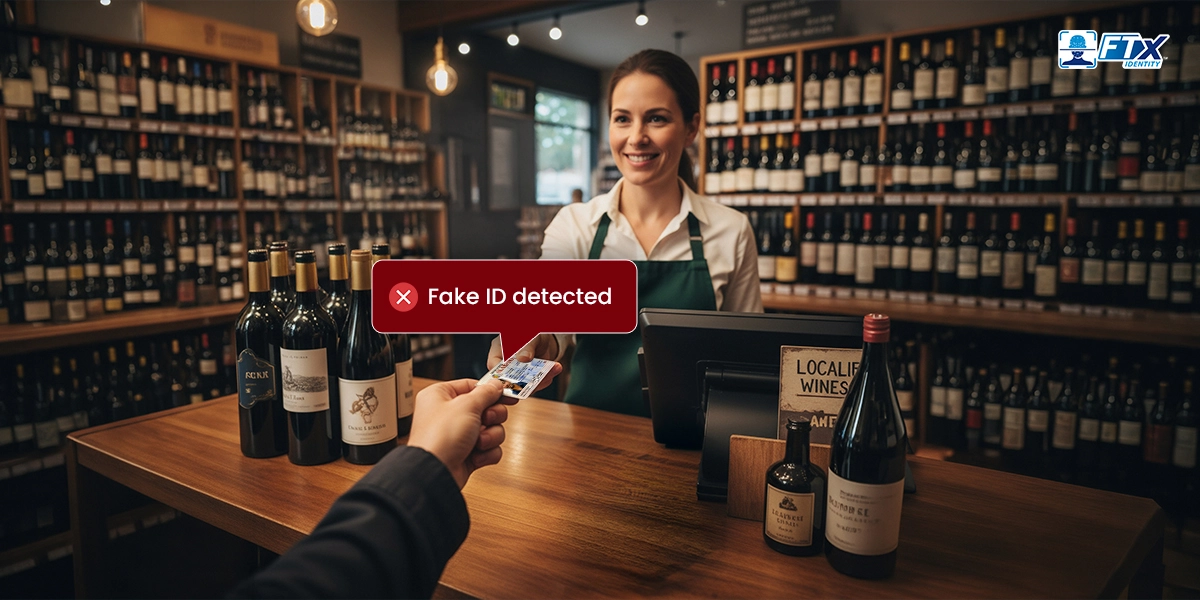
Fake IDs are very prevalent these days. And they’re better than ever. In fact, many of the options sold on popular sites are “guaranteed to scan.”
You might be wondering, how is that possible? How can fake IDs that are sold online scan?
Here’s a simple answer: A lot of fake IDs scan because most ID scanners only check to see if the information encoded in the barcode is in the correct format. Therefore, as long as the barcode is encoded correctly and the data shows the ID holder is of legal age, it will scan like a legitimate ID.
Prevent fake IDs from slipping through!
Explore FTx Identity’s advanced ID scanning solutions.
In other words, the data isn’t cross-referenced against a government database. Therefore, the ID could include a completely made-up identity, and it will continue to scan.
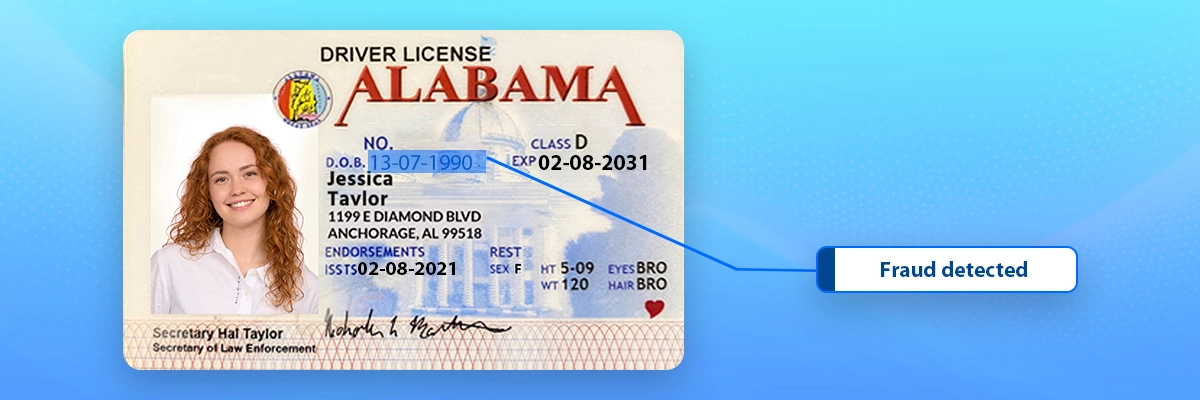
However, this may be changing. AI-based scanners use image processing to scan IDs and compare the ID against official templates. These scanning tools can recognize tiny, telling differences in spacing, fonts, holograms, and imperfections. These tools can spot fake IDs with much greater precision, but the majority of bar and liquor store scanners don’t yet have these capabilities.
Do you sell age-restricted products or services? Beyond ID scanners, there are many other steps you can take to protect yourself. This guide features tips for using ID scanners, as well as other ways to check for fake IDs.
Why Do Some Fake IDs Pass Scanners?
A lot of people think that if an ID scanner beeps, the ID must be real. But most scanners are built to work quickly and make things easier, not to double-check every detail. This is why even fake IDs that look convincing can slip through basic security checks.
Correct Barcode Formatting
Many entry-level scanners operate on a simple pass/fail logic: they only check whether the data inside a 2D barcode or magnetic stripe follows the industry-standard layout. If the barcode contains the correct number of characters and is formatted to look like a legitimate license, the scanner will accept it. It does not know, and has no way to check, whether the date of birth or name in that code actually matches the physical card or a real person.
Lack of Database Verification
Most commercial scanners work on their own and do not connect to the internet. Since they do not have access to a government database or official registry, they cannot check if an ID number is real, expired, or reported as stolen. For the scanner, any ID with the right information in the right spots looks valid, even if it is completely made up.
High-Quality Counterfeit Documents
The black market for fake IDs has changed a lot over the years. These days, people making fake IDs use advanced printers, special software, and top-notch materials to copy complicated security features like holograms, UV patterns, and microprinting. Since these cards look and feel so real, they often get past a quick check, and staff end up trusting what the scanner says instead of taking a closer look at themselves.
Limitations of Scanners
Most regular ID scanners are designed to keep things moving quickly at places like bars, clubs, and stores. They usually lack the high-tech sensors or smart tools needed to catch tiny differences in font, ink, or card thickness. Since these scanners focus on pulling information from the card instead of making sure it is genuine, a well-made fake can easily slip through.
Looking for the best ID scanner to help detect fake IDs? Glance through the top picks for ID scanners.
Why is that possible?
Essentially, ID barcodes are not intended for security. Instead, the barcodes are created to simplify data collection. They enable ID scanners to quickly extract information from an ID, e.g., as you pass through a Transportation Security Administration (TSA) checkpoint, for instance, or visit a liquor store.
Counterfeiters can find the tools and encoding schemes online for forging barcode data, and according to fake ID statistics, it’s fairly easy to create scannable fake IDs. In fact, the majority of fake IDs sold online will scan as legitimate. ID scanners do, however, catch fakes that aren’t properly encoded.
Many states are introducing counterfeit-proofing features in their IDs to prevent fake IDs from entering the market.

New ID Features to Stop Counterfeiting
Many states have incorporated encrypted features that prevent fake IDs from scanning. The most common types of features include:
- Holograms: Many IDs have holograms embedded into the card itself. These holograms are often complex and difficult to replicate, making it harder for fake IDs to pass a scan.
- UV Features: Some IDs have features that are only visible under ultraviolet (UV) light. If a fake ID doesn’t replicate these features correctly, it won’t pass a scan.
- Microprinting: This involves very small text or numbers printed onto the ID that are difficult to replicate without high-quality equipment.
- RFID Chips: Some IDs have radio-frequency identification (RFID) chips embedded in them, which contain information that can be read by a scanner. If a fake ID doesn’t have a working RFID chip, it won’t pass a scan.
- Complex Card Designs: Many IDs have complex designs with multiple layers and colors, which can be difficult to replicate accurately.
- Tactile Features: Some IDs have raised text, distinct typefaces, fine lines, microtext, or images that can be felt. If these aren’t replicated on a fake ID, it can be a giveaway.
- Ghost Images: Some IDs have a smaller, ghost image of the ID holder. This is another feature that can be difficult to replicate.
Many counterfeiters use actual holograms and UV features from real IDs to bypass checks. This makes advanced ID scanners crucial for detection.
Passing Lighting Checks
Holograms and UV features are some of the most difficult to forge. These features can be tested with white light. By shining white light on the ID or exposing it to UV light, holograms and fluorescent overlays are utilized as an additional layer of security.
Because it is simple to verify these security measures with low-tech techniques, today’s counterfeiters will attempt to replicate them as precisely as possible. To pass these checks, forgers either attempt to duplicate these security features or port over genuine versions from legitimate IDs.
The quality of the fake ID and the ID scanner’s complexity determine whether or not it will pass the lighting test on an ID scanner. Relying solely on these tests can give the false impression of security because more advanced fake IDs can duplicate holograms and fluorescent overlays.

What Information Do ID Scanners Gather?
ID scanners typically gather vital ID stats from cards. Therefore, it’s recommended that in addition to ID scanners for bars and age-restricted businesses use questions and visual checks as an added layer of protection.
The types of stats captured by ID scanners include:
- Full Name: The individual’s first and last name.
- Date of Birth: The individual’s birth date to verify their age.
- ID Expiration Date: The date when the ID will or has expired. (Note: Expired IDs do scan. Therefore, it’s important that businesses know the local laws in their states regarding expired IDs.)
- ID Issue Date: The date when the ID was issued.
- ID Number: The unique identification number associated with the ID.
- Gender: The individual’s gender as listed on the ID.
- Address: The individual’s address as listed on the ID.
- Photo: Some ID scanners can also capture the photo from the ID for further verification.
The specific information gathered typically varies depending on the type of ID scanner used and the local laws and regulations regarding privacy and data collection.
Curious about the legal aspects? Check out our guide on ID Scanning Laws by State.
Signs That an ID May Be Fake Even If It Scans
A scanner’s approval is only one part of checking if an ID is real. Even if the barcode works, fake IDs can still have physical flaws or the person can act suspiciously. Pay close attention to both the card and the person’s behavior.
Visual Indicators
Fake identification cards are usually pretty easy to spot. You can tell they are not real by looking at the card. The card itself is what gives it away, not the information on the stripe or the barcode. Look closely for these details:
- Blurry photo: Real government-issued IDs use high-resolution printers. If the portrait looks fuzzy, pixelated, or slightly washed out, it is a strong indicator of a counterfeit.
- Incorrect fonts: State agencies follow strict design guidelines. If the font style, spacing, or sizing of the text looks “off” or inconsistent with what you are used to seeing on IDs from that state, it is likely a fake.
- Uneven printing: Real IDs are made with high-quality machines. If the text looks crooked, out of place, or fuzzy around the edges, it is probably not genuine.
- Missing security features: Most modern IDs include sophisticated elements such as microprinting or distinctive tactile textures. If these features are absent, the card was likely printed using standard consumer equipment.
- Wrong card thickness: Professional IDs have a specific weight and stiffness. If the card feels too thin, flimsy, or like it was printed on standard plastic sheets, it is probably a replica.
- Damaged laminate: Some fake IDs are constructed by gluing a layer of laminate over a printed sheet. Over time, or with poor craftsmanship, this laminate can start to peel at the corners or show bubbles.
- Incorrect colors: Counterfeiters often struggle to match the exact color profile of an official government card. Colors that look dull, neon, or overly vibrant can be a major warning sign.
- Poor-quality holograms: Official holograms should catch the light and shift in appearance when you tilt the card. If the hologram looks static, painted on, or flat, it is a sign that the card is not genuine.
Behavioral Indicators
Sometimes, the person presenting the ID is the biggest clue. If you suspect an ID is fake, pay attention to the customer’s demeanor during the interaction.
- Customer avoids scanning: If a customer acts reluctant to let you scan the ID or tries to hand it to you in a way that makes it difficult to use the device, they may be hoping you will just glance at it and let them pass.
- Provides inconsistent information: If you ask a simple question to verify the details on the card, a person using a fake ID may hesitate or provide information that contradicts the ID.
- Appears nervous: While it is normal for people to be in a rush, excessive sweating, fidgeting, or looking around the room can be signs that the customer is worried about being caught.
- Cannot answer ID details: It is common for people using fraudulent documents to forget what they memorized. If they cannot quickly confirm their address, zip code, or other basic info listed on the card when asked, you should be very cautious.
What Is FEAR & How Is It Useful in Finding Out If an ID Is Fake?
The FEAR method is one of the most useful ways to determine whether an ID is fake or not. It is widely used in the retail and hospitality industry to detect fraudulent and underage identification. This method covers the four steps to confirm the authenticity of an ID and prevent illegal sales.
What does FEAR stand for?
F – Feel
- Check the thickness and texture of the ID.
- Make sure the ID feels durable and that it looks like it stems from a high-quality material.
- Look for irregularities such as edges, ridges, and bumps that would speak to tampering.
E – Examine
- Make sure the photo matches the person carrying the ID.
- Most of the states mention drug or alcohol restrictions on the back of the ID.
- Look for inconsistencies in alignment, spacing, or font size.
- To verify security features like microtext, holograms, and UV printing, make sure to check the ID under good lighting.
A – Ask
- Don’t hesitate to ask for information on the ID.
- When you ask, and if they hesitate or seem nervous about it, consider this as deception.
- Their hesitation is a clear sign that the person is unsure.
R – Return
- If their ID passes every check, return without giving any second thought.
- If you have doubt or it appears shady, contact law enforcement immediately.
- Industries Most Affected by Scannable Fake IDs
Industries Most Affected by Scannable Fake IDs
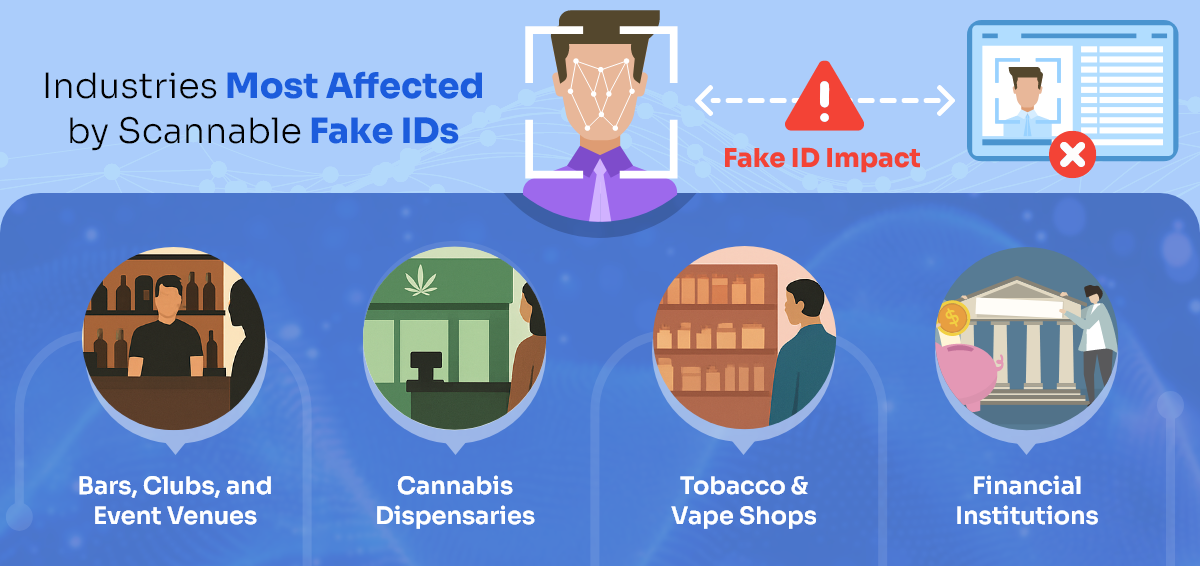
While fake IDs are a concern for any business that sells age-restricted products or services, some industries are particularly vulnerable due to the nature of their operations and the high volume of transactions they handle. Sophisticated, scannable fake IDs pose a significant threat to these businesses, risking hefty fines, license revocation, and reputational damage.
1. Bars, Clubs, and Event Venues
These establishments are at the forefront of the battle against fake IDs. They operate in fast-paced, high-stress environments where long lines and impatient customers can pressure staff to perform quick, and sometimes superficial, ID checks.
Scannable fake IDs that pass a basic visual inspection are a major liability. Allowing an underage person to enter can lead to severe penalties, including fines and the loss of their liquor license. Advanced ID scanners are crucial in these settings to not only verify age but also to track banned individuals and prevent re-entry.
2. Cannabis Dispensaries
In states where cannabis is legal for recreational or medicinal use, dispensaries operate under strict regulatory scrutiny. Selling to a minor is a serious offense that can result in the immediate shutdown of the CBD business.
Unlike alcohol, cannabis sales are often regulated with even greater caution, making robust age verification systems non-negotiable. Scannable fake IDs that appear legitimate can lead to a compliance violation, putting the dispensary’s license and future in jeopardy.
3. Tobacco & Vape Shops
The legal age for purchasing tobacco and vape products is 21 nationwide. This federal law, known as Tobacco 21 (T21), has increased the need for reliable age verification at tobacco & vape shops.
Scannable fake IDs are a common method used by minors to illegally obtain these products. Without a high-tech scanner to authenticate the ID’s embedded data, a business owner could face significant fines and potential criminal charges for selling to a minor.
4. Financial Institutions
The threat of fake IDs to financial institutions is not about age verification but about fraud. Fraudsters use scannable fake IDs to open fraudulent bank accounts, apply for loans, and commit identity theft. The fake ID may pass a simple visual check, but it often contains inconsistent or fabricated data that a more advanced scanner can detect.
Synthetic identity fraud, where a new identity is created using a combination of real and fake information, is a growing concern that relies heavily on convincing but ultimately fraudulent documents.
Barcode Scanner vs Modern ID Verification System
Traditional barcode scanners work well in busy places where security is not a big concern, but they are not good at catching advanced fakes. That is why businesses dealing with age-restricted or expensive items should consider switching to smarter ID verification systems.
| Feature | Basic Barcode Scanner | Modern ID Verification |
|---|---|---|
| Barcode Reading | Scan and read barcode data from IDs for basic information extraction. | Scan and read barcode data with advanced verification capabilities. |
| Document Authentication | Provides limited document checks and cannot fully validate ID authenticity. | Verifies document security features to confirm whether an ID is genuine. |
| Fake Template Detection | Offers limited detection of duplicate or modified ID templates. | Detects fake, altered, and counterfeit ID templates using advanced analysis. |
| Facial Matching | Does not compare the user’s face with the ID photo. | Matches the user’s face with the ID image to verify identity. |
| Liveness Detection | Does not verify whether the person presenting the ID is real. | Uses liveness checks to prevent spoofing with photos, videos, or masks. |
| Fraud Prevention | Provides basic fraud prevention through barcode scanning. | Provides advanced fraud prevention using multiple identity verification layers. |
Limitations of Basic ID Scanners in Detecting Fakes
While basic ID scanners are a necessary tool, they are not foolproof. Their limitations can be exploited by increasingly sophisticated fake IDs, leaving businesses exposed to risk. Understanding these weaknesses is the first step toward adopting a more robust verification strategy.
1. Hardware limitations
Many older or inexpensive ID scanners rely on a simple laser or camera to read the barcode or magnetic stripe on an ID. This technology can be easily fooled by a well-crafted fake ID that accurately duplicates the barcode data.
These basic scanners often cannot read advanced security features like holographic overlays, UV ink, or microprinting. They also struggle with different barcode types or damaged IDs, leading to false negatives and poor user experience.
2. Software gaps
The software powering many basic scanners may only perform a simple data-matching function, cross-referencing the scanned barcode data against the printed information on the card.
This is ineffective against a high-quality fake ID where the printed and encoded data are consistent, even if they are both fraudulent. The software often lacks the ability to check for common fake ID characteristics, such as unusual font styles, misspellings, or incorrect formatting for a specific state’s driver’s license.
3. Offline operation
A significant limitation of many basic scanners is their inability to connect to a real-time database.
They often operate in a standalone, offline mode, relying solely on the information encoded on the ID itself. This makes it impossible to check if an ID has been reported as lost or stolen or to verify the data against a national or state-level database. An offline scanner will simply accept a scannable fake ID as long as the barcode data is consistent with the printed text.
4. Over-reliance risk
Business staff can become overly reliant on the scanner, assuming that if the device beeps or shows a “green light,” the ID is automatically valid. This over-reliance can lead to a failure to perform a visual inspection, which is still a critical step.
A person using a fake ID might present a document that a scanner accepts, but a quick physical check might reveal that the photo doesn’t match the person or that the card feels like low-quality plastic.
Are you ready to effectively prevent the use of fake IDs at your establishment once and for all? Get in touch with FTx Identity to demo our identity verification software today!
Future of ID Scanning and Fake ID Detection
The ongoing cat-and-mouse game between fraudsters and security professionals is driving innovation in the ID verification space. The next generation of ID scanning will move beyond simple barcode checks to incorporate more robust, integrated, and intelligent technologies.
1. Integration with National Databases
The future of ID verification will involve real-time checks against national and state-level databases.
When an ID is scanned, the device will connect to a secure database to verify that the ID number is valid, has not been reported lost or stolen, and belongs to the person presenting it. This is a powerful step beyond simply verifying the barcode data on the card itself, as it authenticates the document against the original source of truth.
2. Mobile ID Verification (mDL)
Mobile driver’s licenses (mDLs) are a digital version of a physical ID stored securely on a smartphone. These are designed with advanced cryptographic security features that make them significantly harder to counterfeit than a physical card.
An mDL transaction uses a secure, peer-to-peer data transfer, allowing the user to share only the necessary information (e.g., just their age, not their address) and giving the verifier a highly secure, non-clonable credential to check. This technology is already being adopted in many states and will become a standard for verification.
3. AI-Enhanced Fraud Detection
Artificial Intelligence (AI) and machine learning are revolutionizing the way we detect fake IDs.
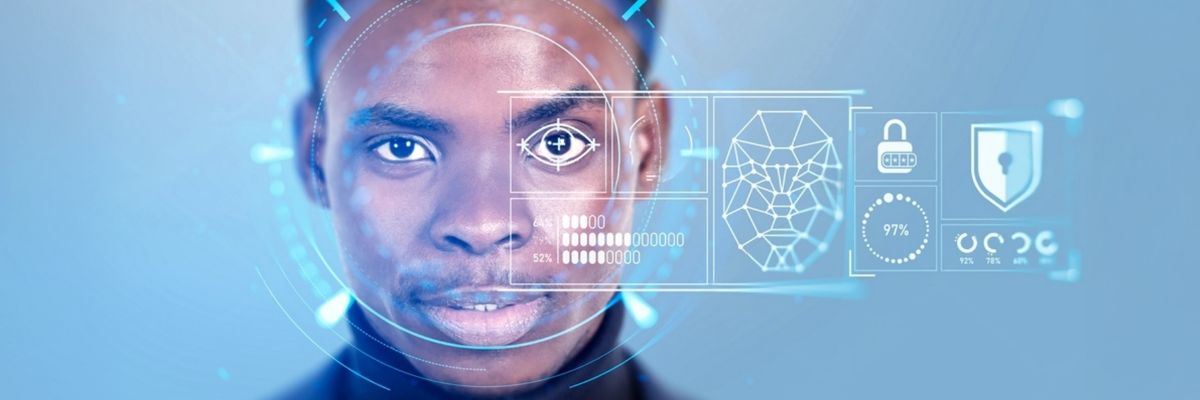
AI-powered systems can analyze a document for a host of subtle inconsistencies that a human or a basic scanner would miss. This includes analyzing the font, alignment, and texture of a document for anomalies. These systems can also use biometric face matching, comparing a photo on an ID to a real-time selfie of the person presenting it, to ensure the ID belongs to the user.
Blockchain-Backed Identity Systems
Blockchain technology offers a decentralized and tamper-proof way to store and verify identity data. In a blockchain-based system, a person’s identity attributes (like their age or address) could be stored as a “verifiable credential” on a secure ledger.
When a business needs to verify an ID, they can simply check the public ledger to see if the credential is valid, without needing to access a central database. This provides a high level of security and privacy, as the user maintains control over their own data.
How ID Scanners Help Businesses Detect Fake IDs
You might be wondering: Is an ID scanner worth the investment if some fake IDs scan?
The short answer is yes! ID scanning solutions – especially digital identity checkers – offer benefits like:
- Fast, convenient ID scans – This is necessary at bars and nightclubs that must serve a large volume of customers.
- Fake ID detection – ID scanners will typically catch the majority of low-quality fake IDs. These won’t include scannable barcodes.
- Pattern matching – The best ID scanners include the ability to detect tiny differences in text and images.
Do fake IDs scan, considering all the factors discussed? Generally speaking, it is possible, although the probability of success is relatively low due to the implementation of advanced proprietary scanning technologies.
Fake IDs are getting through – don’t let them.
FTx Identity stops fraud in its tracks.